golf header

Get Fit for Golf – Get Fit for Life with Luke Hart

Watch this video of Luke Hart, Senior Strength & Conditioning Coach and Fitness Lab Lead at UPMC Sports Surgery Clinic, presenting on the importance of fitness for golf and fitness for life in general.

This presentation was recorded as part of UPMC SSC’s Evening for Golfers online conference in February 2021.
Luke HartLuke Hart is a Senior Strength & Conditioning coach at UPMC Sports Surgery Clinic.

Luke Leads SSC’s Fitness Lab and Health Lab Programmes in our state of the art Sports & Exercise Medicine Department.

Tonight I am going to present on how being fit for golf is being fit for life. My name is Luke Hart and I am the senior strength and conditioning coach here at UPMC Sports Surgery Clinic.

What I want to talk about is being fit for golf is very much the same as being fit for life and the two go hand in hand. I suppose the reason that this has become such a big issue currently, and has become very topical is that in the last year we have seen the players hitting the ball on the PGA tour further than ever before. People like Bryson DeChambeau have really changed the game of golf, so it is a really prominent feature of everyone’s conversation at the golf club at the moment.

This picture here is from the European tour- and it is the gym that goes with them all around the world. This has been happening for the last couple of years. The gyms are following the players and the players now have access at every single tournament, so they can be lifting weights even while they are at tournaments.

We can see that this is something they are actively partaking. You can see on the left there are the players lifting at the Paris Open – lifting some pretty heavy weights. Then we can see Shane Lowry on the right, again lifting a couple of hundred kilo’s there and really doing his strength and conditioning.

There are a couple of reasons why this has started to become more important. We can see that these methods are not really just for the pros – they are actually for everyday golfers, but also for everyday people. It is not just for the young hitters – we can see here the very young man here in the left picture lifting some serious load. Whilst it is for their golf, it is also very prominent for their health in general.

One of the biggest reasons we should focus on strength and conditioning is because in golf if we are on a tee box with 4 of us – probably 1 of us in the past 12 months has suffered from an injury. The most prominent injuries we see are in the lower back, where we see 25-50% of people have had an injury, in the elbow where we see 9-26% of people have had a golf-related injury and the wrist which kind of links in which is a little bit lower between 11-27%, and lastly the knee where we see between 7-21%. The knee is probably that little bit lower because we can kind of get by with maybe a sore knee and still playing, however playing with a lower back issue, an elbow issue or wrist issue is very hard. So strength and conditioning is really a way to protect against getting these injuries and ensuring that you can stay on the golf course for longer.

As we get older the first things we start to lose our strength and power. So it really makes sense that we really work on these things, especially after the age of about 35 we really see them drop off. It is really important we work on them to make sure that we maintain them as best as we can again not only for our golf but for our general health as well.

WHO  Physical Activity Recommendations

This has really been emphasised by the WHO (World Health Organisation). A couple of years ago they put out there position statement on what we should be doing- what a regular healthy middle-aged adult should be doing. That is 150 minutes of light activity and 75 minutes of vigorous activity. Now you can go 150 minutes of light or 75 minutes of vigorous activity. So most of us here who are playing golf once a week and playing 18 holes have already got the 150 minutes of light activity. Golf is very much considered light activity. Probably the component we are missing is that 75 minutes or some of that 75 minutes of vigorous activity, which really pushes our heart rate up.

The other part is the strength and conditioning component. We can see there that they advocate two strength and conditioning sessions a week. The reason for this is the links between having a good base of strength and being injury-free, and then being free and being able to do cardiovascular work has been shown.

If we are quite strong, it means we are less likely to be injured, which means we are more likely to be very active people, which means we are slightly healthier and so it is really important that we don’t see being fit for golf and being fit for life as separate – they are actually one and the same thing.

That is a really important thing to distinguish. It also means that we get better health benefits, improved sleep, improved weight, reduced cardiovascular disease and also reduces our back and joint pain as well, so there are lots of benefits from really trying to get as many of these ticked off as we can.

Why is important to do strength work?

So what we are seeing here is why it is important for us to do strength work. So on the left-hand side, we can see a 60-year-old woman and their muscle. What we can see that is the kind of darker component in that picture is the muscle and the white component is the fat. And what we can see is from 60 to 80 we can see quite a significant deterioration between the muscle and the fat and we can actually see some of the fat going into muscle. Underneath that, we can see the graph that shows how much muscle we have and how it changes as we age. After about the age of 30, you can see that there’s a dip off on that line. Now the good news for everyone here is that this doesn’t have to be the case. We can definitely put some strategies in place to stop this from happening. Exactly what the World Health Organisation are recommending.

This picture is showing a 40-year-old triathlete. We can see the muscle is the darker colour and the white is the fat component. Underneath that we can see a 74-year-old sedentary man, so someone who’s doing very little exercise & very little strength conditioning. We can see how that fat has really exponentially increased and has kind of gone into the muscle. But it’s absolutely reversible or changeable.

So underneath, we can then see a 70-year-old triathlete who looks very much the same kind of muscle architecture as a 40-year-old triathlete. We can absolutely take it from maybe not fully from the 74-year-old man to the one underneath- but we can make vast improvements in this just by putting a few small things into our training plan and into our week.

How do I make these changes?

The next question that I get asked all the time is, how can I do it? What’s the best strategy for making these changes? This was a study that was done and what we can see the area that I’ve circled in blue, is when people combine strength training with endurance training, and they got the best and most significant benefits, and it was significantly better than strength alone, and significantly better than endurance alone.

However, strength was better than endurance. So if in doubt, it kind of shows us that we want to improve on leg strength or improve our upper body strength, strength training is definitely the modality that we should use. But actually, including some endurance training as well as some fitness training, probably doesn’t hurt at all either.

Why is being strong important for golf?

I suppose now to relate this back to Golf-why is being strong really important for golf? Well, clubhead speed has been directly linked to players handicaps. So the faster you can swing the club, on average, the better your handicap will be. Improved long game performance has been shown to improve scores and improve the handicap and has been directly linked to clubhead speed. So the higher your clubhead speed, the higher the improved long game and ball distance. However, we’ve got to be able to transfer that obviously into the golf ball as well.

But then the last reason is that when we’re playing golf, golf is actually a very high force high-velocity game actually has similar kind of forces than that of a javelin thrower. And so if we’re not doing any kind of strength conditioning to protect our joints, to protect our muscles, then it’s likely that we’re probably going to have an injury at some point that’s going to keep us out for a while. When we have an injury, we obviously can’t practice and obviously, our golf performance goes downwards.

So another reason as well, why we want to make sure that we can be like the guy on the right here who is swinging the club 133 miles per hour, up there with some of the best, and why we would like to try and be a little bit more like that if we can.

Strength & Conditioning for Golf

So when we’re thinking about strength conditioning for golf, we think about three key areas, we think about rotational strength, we think about lower limb strength and power, and we’re thinking about injury prevention. What we’ve done for you guys tonight is we’ve created a series of warmups and a strength and conditioning session that you could bring in during this lockdown that you can use to kind of improve your strength, improve your overall health and fitness and reduce your injury risk.

And so the warm-up that we’ve created for you is called the Total Tee Box Warm up – the videos are going to be online afterwards for you guys to look up and it’s essential for those times when you’re really late running to the golf club, you’ve got a couple of minutes before you are on the tee, and you’re just watching the other guys tee off before you, and you want to make sure that you’re warmed up so you don’t mess up those first four holes or get injured on those first four holes.

And so it only takes three to five minutes, and it’s everything that you need as a really basic warm-up before you step onto the tee box, and probably something we can all include on those Friday afternoon games when we’re rushing to the golf club.

Sample Strength & Conditioning Plan

Now, this is the sample strength conditioning plan. You can get this at the bottom there’s a link at the bottom of the screen for this. And it’s a six-week strength conditioning plan that you could bring in. Now, as I said earlier, we’ve tried to keep it really simple for you so that you can do all of this at home. There are one or two exercises that you might need the gym for down the line, but I’ve given you some alternatives in today’s presentation that you can use to make sure that you can do this, whilst in lockdown. You’ll be able to get this plan, and you’ll see all the sets and all the reps are on the program so there’s nothing for you to really have to worry about. And I’ve also included some targets.

Now the targets are obviously age and fitness dependent, but just see how close you can get. And lastly, if you’d feel a little bit nervous about doing these exercises, then please contact us, we run strength and conditioning sessions, or we can point you in the direction of someone that you can see, to help you with improving in these areas or maybe giving you a little bit of confidence or technique going into them but we are going to show you all the exercises tonight.

Trap Bar

So the first one that we saw there is a trap bar now this is one of the ones that you might need some gym equipment for. But also you can also do this with anything that you have at home, so I have guys doing this at the moment with dumbbells we have people doing it with bags of books, it’s essentially lifting a weight off the floor and lifting it correctly. And so, my colleague here is lifting it from the front, and from the side.

And the most important thing here to really look at is how he’s using his hips, and his knees, so he’s bending at the hips first before bending at the knees and that’s to make sure that we’re using the hips to lift the weight. The other two things that I want to focus on if you’re doing this at home is making sure that you have a nice neutral flat back, that is not curved, or it’s not overextended, and that your shoulders are sitting roughly in line with your toes.

Now, this is an exercise that using all the pictures I presented tonight, which is why I wanted to show it to you it’s a fantastic exercise. It’s really good for building that explosive strength for your golf. It is called a trap bar and we recommend you kind of do four sets of eight, or five sets of five, depending on what weight you have at home.

Goblet Squat

Now if you don’t have access to that, this is why we’ve included this second exercise called a goblet squat now on this one we’ve shown it with no weights, but you can also include weight and you just hold it on your chest, when you include it with weight.

All we want to do is, essentially, sit back onto a chair. And the reason we want you to use the chair is because it really encourages you to use what we call your posterior chain. Basically, your backside and hamstring muscles, along with your quadriceps on the front of your leg. So you can see here, he is really sitting back onto the chair. We’re making sure the knees don’t go past the toes and his chest, and we can see the badge on his chest is always staying proud.

Again on this one you probably want to do, roughly between four sets of eight. If you can and if it was easy, then you can hold a little bit of weight on the front of the chest, and obviously, for more athletic members in the audience, you can hold some significant weight or eventually when the gyms open back up, you could pop a bar across the chest or on the back to make this one a little bit harder for you.

Split Squat

Now, this is an exercise called a split squat. This is a single-leg exercise, and we know with golf, obviously, we have our back leg, and our front leg, and it’s really important in golf to make sure both the front and the back leg are both as strong as each other. And that’s why we’ve included this exercise and it is a good bit harder than the previous one that I showed you.

There is a couple of really key technical points on this. The first is you will see how we are using the chair to make sure the knee is not going over the toe. All we want you to do is pop your toe underneath the chair to make sure you keep the shin nice and vertical.

The second one is, you can see that my colleague’s chest here is nice and proud and that her back knee is sitting directly underneath her hip. What we don’t want to see is that knee behind the hip, otherwise, that encourages a big arch in your lower back. And this is quite hard so for some people in the audience you might raise the back knee up a little bit, and for others, it might be a little bit easier so you’d hold some weights in your hands. This is where the four-litre bottles of the water from Lidl and Aldi come in very handy.

Wall Squat Hold

This exercise is called the wall hold. Now, this is a fantastic exercise. This is an exercise that everybody can do. We would have everyone from our knee replacements, to our athletic individuals do with this. It is a fantastic one, that shouldn’t cause you too much soreness either. And the aim of this one is four sets of 45 seconds.

Now you’re seeing again on this one that we’ve got a lovely flat back, and you want to imagine you’re pushing your lower back into the wall. The other one is we want vertical shins, again and we want to see the knees in line with toes we shouldn’t see the knees kind of going inside the big toe, or outside of the little toe. And we want to try and hold for four sets of 45 seconds.

Hip Thrust

So the next exercise is the hip thrust. Now, this really is going to work your backside muscles and it’s great for people with lower back pain.

So whereas some of the exercises before this have been all focused on making sure that we develop strength and looking after our knees. This one is now looking after our lower backs. Okay, so it’s a great one for anyone who’s had lower back pain. Three key things that we’re looking for when we watch this video you see her ribs are lovely and flat. Her legs are at 90 degrees, and she’s squeezing her backside at the top of the movement.

And when we do this we really want to make sure like I said that we keep those ribs flat. That is to make sure we don’t have any arch in the lower back, and you should never feel this in your lower back, you should always feel it in your backside muscles. And that’s why it’s going to really help us with our lower back pain because the stronger we can get our backside muscles, the less our lower back should have to do. We also have a slightly harder version to show you, this is where we lift one leg under a single leg so those of you are brave enough you can challenge yourselves on this one, but we’ve really got to make sure the foot is nice and close to the backside and it’s not too far away. Otherwise you’ll feel this in the back of your leg rather than up into your backside muscles.

Band Rotation

So, we’ve looked after the lower back, and we’ve looked after the knees, but now you remember there was that circle, which was kind of encapsulated rotational power.

And so this is a really important one for us golfers, we can build all the lower body strength in the world but if we can’t relate it back to our golf swing then we’re probably going to struggle a little bit, but also this is a great one for building up our core and making sure we’re protecting our lower backs.

So again three key things I want you to work on with this one is making sure your ribs are down or flat, you don’t have a big arch in your lower back – that you have a small range of motion, you shouldn’t be twisting it like your golf club – you should be making sure it’s a much smaller range of motion, but you should be in your golf stance, so if you imagine when you watch my colleague do this one. You should imagine you’re addressing the golf ball with soft knees a little bit of a push back in the hips exactly like you’d be kind of approaching over an iron shot. You can see here that he’s only moving from big toe to big toe so very small range of motion, and that his lower body is staying completely straight forwards. You shouldn’t see your knees or your hips turning. It’s just the upper body that’s doing the work and you should feel it all in your abdomen area. You should very much feel this is a core exercise.

If you are doing this one, and you feel it in your arms. That’s because we’re starting to use the shoulders a little bit too much, and not using our core enough so that’s one little tip to look out for. And this is like I said a fantastic exercise for translating power into our golf swing but also protecting our lower back.

Push Up

We are now going to move on to a little bit of body strength. Now there’s some good evidence that a good upper body does carry over into our golf swing, but also looking after our shoulders, our upper back, our arms, elbows and wrists is really important and doing a little bit of pre-emptive work to make sure that we don’t get any injuries and that’s what this is all about.

So with our push up, quite a common exercise, but we’re just going to go through a few things that we shouldn’t do. So when we’re doing a push up, we shouldn’t see the elbows flare out to the side. We shouldn’t see the lower back sag at all. In fact, if anything, we should see a small curve in the lower back, or that lovely straight line that you can see my colleague here. The second part is you see his elbows are slightly tucked, so they are not chicken winging out. And we’re looking for three sets of eight. Now, for a few people in the audience, this might be a little bit tricky to start with so you can also do the knee variation, where you’re on your knees.

And again, when we do this, we want to make sure our hips aren’t sagging down, because that will actually ensure that we’re using our core and using our lower back muscles to really strengthen them up, and again three sets of eight, and you can gradually progress up to the full variation.

Bicep Curl

Next is our bicep curl. Now, this one you have to be a little bit careful with too much of it is not too great, but also we don’t want to not challenge those muscles at all.

So we just want to do a little bit. So this might be one where you only do it once, maximum twice a week. We don’t want to go too heavy, we want to go nice and light. We’re just looking to stimulate the muscles around the elbow to make sure that we’re working them – so when we do eventually play a little bit more golf maybe we go away on a holiday and play a couple of games in a row, or we go from winter and transitioning to summer, those muscles are strong enough to handle the amount that you’re using and the amount of swinging the golf club.

So a couple of things to look at here and make sure we keep the elbows into the sides. And that we’re not swinging through the lower back it’s very controlled movement, and some people like to stand up against the wall which isn’t a bad idea, but making sure that we keep the weight nice and light to start with, especially if you haven’t done these before.

Wrist Flexion, Extension, Rotation.

The last one that we can do, is the wrist flexion, extension and rotation, and again the exact same caveat, as before we shouldn’t be doing these too often once a week is absolutely fine unless you have an injury in which case you should be guided by your physio on how many to do. We want a nice light weight, so about a kilo or two kilos. If you don’t have the weights then a one-litre bottle of water weighs about roughly one kilo.

And you can see this is the flexion. So this is where the forearm is completely supported – the side of your dining room table is fantastic for this. And we’re just bending the wrist up towards the elbow. The extensions now, where the wrist is coming back towards the elbow and nice and slow and controlled. And again, use this table to support the forearm and nice and light weight in your hands. And the last one which is rotation which is where you’re going to rotate the wrist. So from that position there you rotate the wrist over.

Take away

So with all those exercises there, we have made sure that we looked after four key areas for injury, which was our lower back, our elbows, our wrists and our knee’s. We have also looked at a little bit of rotation, to make sure that the strength work that you are doing carries over into your golf swing, but also that we are working to protect your lower back.

A couple of things I wanted to go through: the first is to take it very slowly. If you have not done any of these exercises before you just want to gradually introduce the exercises want to go from completely doing nothing to doing lots of them because that can raise its own issues. But once you are comfortable, you want to make sure you are progressing forwards. Increasing either the weights or sets when it becomes too easy for you and at the moment with lockdown that can be quite tricky so you might find that you have to be doing a little bit more reps or sets because there may not be more weight.

Consistency really is key – doing these exercise’s consistently over one year is much better than being perfect and trying to go hard for three months.

We see much better results when we are consistent and keeping to a steady amount rather than trying to go from doing not too much to going through every day, or going through 4/5 times a week. So making sure that you bring in good habits now and that you will see out the rest of the year with, will give you much better results.

Fitness Lab

Lastly, we have our fitness lab here, which can help you with all of the things that we’ve spoken about. Now, we’re very lucky that it’s covered by the three big major insurance companies Laya, VHI & Irish Life but it is something that if you’re interested in golf and you’re interested in fitness, or you want to just see where your current fitness levels and health levels are.

We have FitnessLab and we have HealthLab, available, which you may be covered for with your health insurance, but we also offer strength conditioning advice as well. So if you’re interested in learning a little bit more about this maybe testing to see where you’re at, you can email us at [email protected], and we can help you with the program, we can design your own individual program. And we can really help push you forward if that is of interest to you.

Thank you very much.

Click on the links below to download PDFs.

Sample Strength & Conditioning Programme

Mobility & Flexibility Exercises for Golfers

Please note this programme is for sample purposes only and it is recommended you consult your physiotherapist / S&C coach before starting.

If you would like to make an appointment with an UPMC SSC Sports Medicine Consultant or S&C Coach please contact 01 526 2030 or [email protected]
To make an appointment with a member of the Sports Medicine team at UPMC Sports Surgery Clinic, call 01 526 2030 or email [email protected]
Ann Maria Byrne Elbow specialist SSC

Common Wrist Injuries in Golfers – Ms Ann-Maria Byrne

Watch this video of Ms Ann-Maria Byrne, Consultant Orthopaedic Surgeon specialising in hand, wrist and elbow injuries at UPMC Sports Surgery Clinic.

This video was recorded as part of UPMC SSC’s Evening for Golfers online conference in February.

Ann Maria Byrne Elbow Surgeon

Ms Ann-Maria Byrne is a Consultant Orthopaedic Surgeon at UPMC Sports Surgery Clinic in Santry.

Ann-Maria specialises in elbow, wrist and hand surgery as well as sports injuries and joint replacement.

Thank you for joining this evening. I am Ann-Maria Byrne. I am a trauma and upper limb surgeon and in UPMC Sports Surgery Clinic I specialise in Elbow, Wrist and Hand surgery. It is a state of the art surgical unit, where we see patients and operate on patients also. I find it a great place to work because I have involvement of a lot of my Sports Medicine colleagues, Physiotherapists and world-class Radiologists as well, and also I have good links with other surgeons who would also deal with sports injuries and things we are going to talk about today. It is one of my favourite places to work.

What I see in my practice is every kind of upper limb injury. Certainly, while the majority of people looking in today will be golfers, you probably do a bit of yoga, you may do some running you may play a bit of tennis as well – and a lot of the injuries we are talking about now will cross over all of these. Of course, when we are looking specifically at the golfers – there are particular injuries that are associated with golfing. While we are mainly talking about the wrist, we can’t ignore the elbow because the wrist and elbow are joined by the forearm and both of them work in tandem. When one is injured it affects the other and vice versa. I always think of it as being a linked joint there between the wrist, elbow and forearm.

What we want to do from this discussion is really look at ways where you can avoid injury and where you can enjoy golf at every stage in your life. I have to say in my defence I am talking today as a surgeon and not a golfer. I do play golf but at a level purely for pleasure rather than for competitiveness – so anybody who is watching who has ever played golf with me or has seen me play golf, remember I am coming from a surgical side this evening. The important thing that we have to think about and look at when we are looking at a golfer is that there is a very specific pattern of swing. You have to take into account obviously the shoulder which we are not talking about today, but the elbow, forearm and the wrist.

The wrist and elbows, each side works in opposite motion paths – one does the opposite of the other. The dominant or trailing upper limb or wrist works more in flexion and extension so its this motion. Whereas the non-dominant, which is the lead wrist and that will be the left side, on a right-handed player, they will be more in rotation, showing rotation, and also ulnar and radial deviation. So when I talk about ulnar sided problems, I am always talking about problems on the little finger side of the wrist and that’s where we see a lot of the injuries on anybody playing golf. I see it in hurlers as well or anybody using a bat or tennis racket or things like that but certainly, in golf, the research has shown that well over 60% of patients will present with ulnar sided wrist pain. And it’s important to take that into account because that is your lead wrist or the non-dominant arm and is related to the biomechanics of the swing, and that’s important in terms of working on your swing physiotherapy later on for upper limb injuries to take that into account.

So the common sites of injury for golfers are obviously what I see the wrist, elbow, shoulder. I don’t look after the neck or lumbar spine, but they’re well-known areas of injuries, and it is all related to swing. Certainly looking at amateur golfers or non-professional golfers over 50% of players will get an injury at some stage during the year. It’s slightly different this year during COVID times because I think people have been playing more often, and then locked down, and then playing again more often. So we’re seeing a different pattern of injury this year, but it certainly is there in the recreational golfers. And then, over 80% of players are presenting with overuse, and this is technique problems causing injury. So these are overuse injuries related to the swing. Acute injuries such as fractures, or hitting the ground and causing acute pain and tendinitis account for about 17%. But over 80% of overuse and technique related issues.

In terms of the recreational players looking at the literature, low back pain is seen in a vast majority with elbow and wrist injuries are way up there as well, and certainly, it’s been found in men, the issues of back pain seem to be more prevalent, whereas in women, there are increased rates of injury to the wrist, elbow and shoulder, and I think that’s related to women trying to get more power behind their swing and trying to get their shots further. With issues with core, then they can cause issues to their wrist, elbow and shoulder because they’re using those preferentially rather than their core. The risk of injury and golf is associated, as I see very much at the moment during COVID, is with increased frequency of play. What we’re seeing is a pattern where people are playing more often and as a result of getting overuse injuries and then there’s a lockdown the golf clubs, unfortunately, are closed. They’re not playing, and then going back to the same level that they were playing at before and getting injuries just as they returned to golf. So the increased frequency of play is associated with recurrent micro-traumas to the upper limbs, tendons and the joints and this causes the injuries.

Also, in people who present with general poor conditioning, so somebody who’s not as fit as they should be, but is out playing there 18 holes of golf, three times a week, and then has back pain or hasn’t worked on their core stability is at increased risk of injury to their upper limb because they’re relying on their upper limb to get their swing, rather than using their core at to actually propel the ball. Patients presenting with decreased flexibility I also find have increased risk of injury, particularly with elbows and wrists. And as people get older, their tendons get shorter and stiffer.

So, younger people who can go off and not stretch, not do their workouts and just go ahead and play – they are the envy of us all. But the rest of us as we get older, unfortunately, have less flexibility, and as a result of this, we can develop further injuries in our tendons, particularly with increased frequency of play. Then looking on the other side at technical issues. Obviously, the poor swing and techniques with poor swing is a big problem I’m going to talk about that later on. Failure to warm up, and we are all guilty of that, I know I’ve jumped out of the car, grabbed my golf clubs, run to the first tee because I’m late for my tee time and haven’t warmed up and I always pay the price later on that day or the next day, where I get my problems in my wrists forearms and elbows. So warming up is something that is absolutely imperative to avoiding injury and ensuring that you get a good play and that you continue on to play long into your later years without injuries, and that’s what we want in golf is to enjoy it and to be able to play from the amateur to competitive golf.

Specific things with golf that you see injuries with are where you’re striking the ground or on rough ground. And then we have to take into account other injuries. So people who have had for example shoulder surgery for maybe dislocation or a rotator cuff injury, and is then returning to golf, they need to look at rehabilitation for all of their upper limb, not just their shoulder, because if they’ve stiffness in their shoulder, they may change their swing and then rely more on their wrist and elbow, and as a result of that, be more at risk of injuries to those sites, and that’s just very disappointing when they’ve come through a period of time away from play for recovery and then to get an injury elsewhere is disappointing. So it’s not just thinking about, you know, if you have a pain in your wrist or elbow, but do you have back pain or shoulder pain, is there something else that is causing you to put increased loads on those other joints, and that has to be addressed as well.

Looking at somebody who has a sports injury, or is wanting to return to sports after an injury, the goals are the same across the board. The first thing is the assessment of the injury or any associated injuries. Assessment of the player’s functional requirements and that changes very much from the player who wants to go out and play nine holes, just for a bit of relaxation like myself, or somebody else who is playing at a very high level competitively, and we need to see what they need to get out of this, and the time that needs to take away to recover. We need to do appropriate investigations so for fractures, the first line is playing x-rays. We don’t always jump in with an MRI scan because it is not appropriate. In other places, an MRI scan or a CT scan may be more appropriate. But this has to be taken into account with an appropriate physical examination because certainly, I have had patients who have come into me who’ve organised scans through various sources and then I’ve had to send them for my own scans because unfortunately, they were the inappropriate investigations so that’s just time wasting for everybody, so appropriate investigations are very important and based on those investigations and the clinical assessment of the injury, we decide on definitive treatment.

After the definitive treatment, then we need to look at what the sport is, in this case, Golf, and then the player-specific rehabilitation. Working on time away from sport and then gradually returning to sport in a safe manner is my aim so that you don’t get problems later on. And then surveillance on the complete recovery and that is throughout all sports injury management- it is the same pattern of treatment there.

So looking specifically at wrist injuries. I mentioned earlier on about swing mechanics – everybody has their own swing. and a lot of us have taken up very bad habits down through the years and we’ve gone to various professionals to try and train them out of us. The one that causes the biggest issue that I see, certainly for the wrist is casting. Casting or scooping is something that is used that comes from fishing. And when you’re fishing you need to use this movement of your wrist to cast off your line, and it is appropriate that’s done in that set setting. However, with golf, when you are bringing your swing down to hit the ball, it is important that the hand reaches the ball, before the club so that the alignment is appropriate.

If you start to engage your wrist and rotate and use this ulnar deviation or casting movement of your wrist, before you hit the ball, it means that the pressure goes up from the ball through the club and into the wrist and it causes problems to the ulnar side of the wrist and as we mentioned that is the side that’s below the little finger there. And you can get tendonitis in the tendon on that side, which is the ECU or extensor Carpi Ulnaris, but I see that in golfers and I see it in hurlers as well, and it is a technique issue with overuse or movement or this casting scooping motion when hitting the ball so, avoiding that type of motion will help – number one, with increasing your power and the distance of your shots, avoiding a high loft, which is not always what is the aim of your shot and decrease the risk of injury. So, avoiding casting is important.

These are just images, again, of the cartilage, which is called the TFCC on that ulnar side of the wrist here. And what I see are people who can have wear and tear changes there, and they may hit a root or hit the ground and get a further injury to the ulnar side of the wrist. This presents with pain- pain on this casting motion or we call it the dart throwers motion and swelling. Usually, I’d organise an MRI scan for this. There are some people who have different shapes of wrists who are more prone to this kind of injury or problem on this side of the wrist. And then, it can flare up every time you hit the ball, and this is usually on the non-dominant side – the leading side, or the leading wrist in a right-handed player – that’d be the left wrist.

Sometimes we have to go in and look at this depending on whether it’s an acute or chronic injury that we’re seeing. Most of the ones that I see are patients who have presented with on and off twinges in their wrist and then have had an acute event, and that kicks everything off and we will talk about treatment later on.

Specific things again that we see with golfers, these are not common injuries, but they are common in golfers, and I see a good few of them. These are where you’re holding your golf club, you hit a piece of rough ground or a root of a tree, and the golf club actually hinges and goes into a bone on this side of the wrist again, the ulnar side of the wrist, called the Hamate, and this has a hook, and beside the hook are your tendons to your ring and little finger and then various arteries, nerves and veins and this can fracture. People come into me with pain and pressure in that region, and they can’t play because of pain. So this is a specific injury that we see that is due to the golf club going into the heel of the hand from hitting the ground.

Other injuries that you see on that that are not acute injuries or fractures, but it is due to compression of the nerves and blood vessels on that side. And again, it’s recurrent microtrauma, and it is due to technique, unfortunately, or grip issues, and oftentimes I would have to explain to people that they will have to change their grip on their golf clubs before they return to full play. Other things that I look at in the wrist and the hand in golfers, and this can happen at any age, and it can happen in patients presenting to me at any level, whether there be amateurs or, professionals – this is tendonitis and arthritis. This usually isn’t specifically related to playing golf, but these are with people who are working in their office, and then maybe going off to the gym to do whatever sport they do there, and then going to play golf or maybe people who had old fractures or injuries, and then are presenting with arthritis.

They wish to play their golf, but they’re having pain. So the ones that I see most commonly are tendinitis in the wrist and I see a lot of tendinitis in the tendons on this side of the wrist, going into the thumb. I’m seeing it more and more related to computer work, texters thumbs. I’m seeing it in young mothers, fathers, and often grannies and grandads who are looking after their grandchildren who are lifting their grandchildren, and they get pressure on the tendons on the outside of the thumb, and as a result of that, they get pain, swelling, and then difficulty with holding the club and pain in their thumb as they go through their swing. That certainly is not specifically related to golf, but it is something that stops people from playing golf, because of the pain in that region.

The other group of people are people who have arthritis and, obviously, this comes to us with too many birthdays. As we get older, everybody’s going to get problems there and again, with playing golf, and with the grip of holding the golf club, you can get pain at the base of the thumb. It’s one of the most common areas to get arthritis, after the hip and knee, and we see it across all walks of life. I see it most commonly in women, and it’s probably related to various jobs that women do in the house that are repetitive going on over the years, where they get pain doing their own buttons, ringing out a dishcloth- the pinch grip is particularly effected and then, unfortunately, holding a golf club that’s an issue as well.

So these are all the areas that I look into that are, again, issues that cause problems with playing golf but these specifically are not particularly related to a golf injury by themselves.

The initial treatments for any problem, whether it be an arthritic problem, a tendinitis problem, a cartilage problem is rest. So it’s taking time away from the sport, or the activity that’s initiating your discomfort and pain. So the first concept is RICE: rest and ice the joint, or the area that’s hurting you. The next thing is to immobilise the joint, and that is to stop the joint from moving. So I just have a picture there of a wrist splint to stop any wrist problems. If there’s thumb or tendon involvement in the thumb, I would use a thumb splint that involves the immobilisation of the thumb as well. And then a short course of anti-inflammatory medications where are appropriate is useful as well. And that is to help with acute injury, pain, and to help any swelling.

Now, obviously, if there’s any evidence of an injury like a fracture, that needs to be investigated further with X- rays and further imaging- that would be a trip to your local emergency department, but certainly most injuries that we see are overuse injuries, unfortunately, and the first line of treatment is rest, and then going into looking at technique further treatments, physiotherapy, rehabilitation, and then possibly down the line surgery is a role.

Unfortunately, I would have a lot of people who come to me who are hoping that there’s a quick fix, with an injection, but what my role is actually to pull back on everything, investigate and make sure that the appropriate regime of treatment is used, but a lot of the time, it is overuse and stopping resting and reassessing the situation and technique is the way to go. With golf in particular, as well as the swing and the technique of swings the golf grips is a big issue, and I do ask people to attend their local club professional for advice with regards to this, to help them improve their golf and avoid injury.

So we cannot just talk about wrist injuries and problems with the rest without talking about elbow as well, because I think one always affects the other it’s you can’t avoid one without the other. And I’m sure you’ll ask why I’m starting off with tennis elbow, and that’s because tennis elbow is way more common in golfers than golfer’s elbow actually is. Tennis elbow affects the leading arm and golf, and this is a pain in the elbow on the outside of the elbow, and it is an overuse degenerative tendon condition. It goes away with rest, but unfortunate if you want to go back and play your golf, you have to learn techniques to avoid recurrent injury to this side.

I see as more and more people who are doing gym work to try and strengthen their arms and their core to help with their game, and particularly in people lifting kettlebells. So I see people who are working on a computer for maybe eight hours a day, all their muscles and their forearms are tightened up/tensed up/shortened and then they go off and do a regime of kettlebells and play golf and unfortunately that is a recipe for disaster where you get tendinitis and pain where you just can’t play the game that you wish.

We see people who do a lot of repetitive wrist rotation as well, who get pressure going up along their forearm, extensor muscles and into the lateral or outside of their elbow, and this causes a lot of problems and discomfort for them as well. Just at the bottom screen there you can see where the tendon is affected on the outside of the elbow there and you can see the black tendon where it’s pulling away or getting micro-tears in the tendon. This doesn’t happen overnight, it’s with time. And unfortunately, it takes time to recover from this as well.

Golfer’s elbow, on the other hand, is on the inside of the elbow, and that is pain and tenderness on this side, and you get radiation along the forearm musculature into your fingers and actually, I see this more commonly in rock climbers than I do in golfers but it can happen obviously in any sports or any activity with overuse. Some people come in and they complain of stiffness as well, and difficulty making a fist because of a pain radiating up onto the inside of the elbow. Some people have weakness in their forearm, hands and wrists that can be related again to overuse, to cam be related to nerve issues and it’s also related to pain, so the pain limits the power that you have in your hands and wrists.

On the inside of the elbow is what everybody will know as their funny bone. So when you hit your funny bone on the inside of the elbow, it is the ulnar nerve, which supplies sensation to the ring and little finger, and you will sometimes feel an electric sensation running down to the ring and little finger and there are people who obviously have medial epicondylitis or golfer’s elbow, but this can also be in association with ulnar nerve issues.

When I’m examining a patient, I will always include this as part of my examination, because people who are not settling down after treatment for medial epicondylitis, or golfer’s elbow must be investigated for the ulnar nerve because they’re so close together, one can affect the other so you can’t rule out issues with that, that are closing and similar symptoms. Some patients present with what’s known as Country Club elbows. This is where you have tennis elbow on one arm, and golfer’s elbow on the other arm. It is always tennis elbow on the leading arm and golfers elbow on the following arm. My main aim with patients presenting like this is to advise on technique modification, and it’s always involving a good tennis professional to guide them on their swing- and sometimes I would send people as well to see our sports and conditioning specialists who will guide them on their swing and guide them on to activities to work on their strength and avoid injury in the future.

I also suggest looking at the grip on their clubs because sometimes the grip is slippy or is not appropriate or the clubs are a wrong length. As a result, this causes them to have a defect in their swing, causing problems for their wrists and elbows. Obviously, it’s easier said than done but avoiding hitting the ground is always a good way to avoid injury to the wrist and elbow. The other option as well when playing is the use of a tennis elbow or golfer’s elbow brace. These are the same thing. They are not a support brace for the elbow. They are a counterforce brace- so what they do is stop the pressure from the rotation and movement of the wrist in travelling up to the elbows causing pain.

So management of any elbow condition, and also a lot of this will treat the wrist, also. So both areas will be treated with this type of regime, is looking at stretching, warm-ups, and eccentric stretching. This is the movement where you’re stretching your forearm musculature to lengthen it and make it stronger, and to make sure that the muscles are nice and long to compensate for any tight, short or unloaded tendons and these are the ones that cause problems with injury. The tennis elbow brace you can see there in the bottom picture and you can see that that position is treating a tennis elbow because that’s the pressure point is protecting pressure going up the arm to the outside of the elbow. You can rotate that to treat golfer’s elbow and use the pressure points on the inside part of the elbow and this is always below the elbow because the pressure is running from the hand and wrist up to the elbow, not the other way round for these type of overuse injuries.

I’m going to mention injections very quickly and there are different types of injections. For tendon injections, there are options of local anaesthetic, steroid or PRP which is activated plasma. Steroid injections are purely for pain relief, they do not cure the underlying inflammatory or degenerative problems with the tendons. I’m very clear to patients when they come into me. This is not a quick fix, unfortunately. Without appropriate rehabilitation, time away from sport, and then a gradual return to sport, they will fail in their treatment regime. So injections are purely for pain relief, not curative for any of these overuse conditions. PRP injections are more invasive in that they do cause an inflammatory reaction around the tendon. This can help the tendon to heal and regenerate because of all the growth factors, and various other factors that are in the plasma that is taken from the patient’s own blood. I always refer patients to my sports medicine colleagues for those injections. These are selected for specific patients, based on their clinical exam and imaging and may not be suitable for everybody, but there are good success rates in the literature for tendinopathy issues.

With regards to the wrist, the research isn’t there with regards to PRP. For pain relief, for TFCC tears, for tendinopathy, again steroid injections are good options, but without adequate rehabilitation, time away from sport and splinting, they alone will not work. In selected patients based on their clinical examination and their scans, surgery is an option. and that varies from patient to patient and what the problem is. There are options in terms of repair of tendons, the release of tendons, nerve release as necessary and treatment for arthritis if necessary as well. These surgical options are there but are very much based on the patient and on a case by case basis.

In terms of exercises- I do, particularly during the lockdown, have a lot of people who have tried to do their own regimes at home and when I talk about working on their core and working on various activities- they go off and they’re doing as much as they can in the gym. But there are specific exercises that do cause issues for the wrist and for the elbows. These are to be limited or avoided- particularly in the early stages after an injury. Obviously with yoga doing any axial loading or leaning on the wrist in this position will put pressure on the ulnar side of the wrist. Also in patients who are doing chin-ups, push-ups or planks that puts a lot of pressure on the flexor muscles, the elbows and the wrists- so these are to be limited or avoided or to be carried out in a controlled environment under the direction of a sports therapist or physiotherapist.

So the take-home message today really so that you can continue to enjoy your golf and to avoid injury is the importance of proper warm-up and stretching. If you have had an injury, and you’re returning to golf and at the moment people are not playing so when you do return to golf and lockdown is lifted, you need to carry out a gradual increase in the length and intensity of play. This is to avoid overuse injuries. Working on general conditioning and core muscle strengthening will definitely help your swing mechanics and avoid injury. If you have an injury to one joint in your upper limb, it’s to be careful in return to play to avoid injuries to your other joints, so it’s about gradually increasing your intensity of play and working on your core strength. Instruction with a golf pro to refine your technique and look at the technique or indeed with our sports specialists is also something to be recommended. Anything that improves your swing improves your technique will certainly increase your enjoyment of your golf, and what you want to be able to do is to enjoy it, injury-free.

Thank you.

For further information or to make an appointment with a Consultant Orthopaedic Surgeon, please contact [email protected]


Evening for golfer's 2020

An Evening for Golfers – Q&A Session

Watch this video of the Q&A session at UPMC Sports Surgery Clinic’s Evening for Golfers.

At this event, Ms Ann-Maria Byrne, Consultant Orthopaedic Surgeon presented on wrist injuries in golfers and how they can be prevented and Luke Hart Fitness Lead at SSC Sports Medicine presented and demonstrated exercises for increased mobility, flexibility & injury prevention.

This video is suitable for anyone interested in keeping strong, flexible and active as they get older and for anyone with hand wrist or elbow injuries.

Answered by Ms Ann-Maria Byrne

I suggest that people try a period of rest, then obviously attend to a physiotherapist. I often get referrals from physiotherapists for people who are failing an eccentric program and a loading program for the tendon, and then I’ll see them. I usually would give them between three and six months of physiotherapy and then I will want to assess them, check an MRI to make sure there’s no other pathology going on or any nerve issues because they’re so close by the common area of the inside of the elbow is associated with that – so anything between three and six months.

Answered by Ms Ann-Maria Byrne.

No, I recommend to use it as a counterforce. So as the force is moving up through the forearm, it stops the forces going up to the delicate tendon around the elbow. So you wear it while you’re playing golf, or when you’re chopping vegetables when you’re bringing out the rubbish- when you are active, that’s when you do it so it’s not just about the golf, it’s the other things in your life as well that bring on these problems and symptoms. Golf is just one part of the things that cause all these issues.

Answered by Luke Hart.

Yeah, that’s a great question. I think the first thing is that we’ll find a lot of people have MRIs with similar findings. So, 30% of people over 30 will have the same findings and when we get to 60 years old 90% of people have some sort of findings on their MRI. So if you’re not in pain and you haven’t got any issues currently I wouldn’t worry too much about what the MRI is saying, in terms of a lot of people have those findings, but absolutely some of the exercises we’ve gone through today, especially glute bridges and hip thrusts they’re excellent for anyone with lower back pain, especially as a warm-up. Obviously, it’s hard to do those at the course so you do them before you go to the course, and then, obviously, head over to the course. And then a good warm-up is essential really to establish normal movement, especially if you’ve had to drive to the course. So I think, warm-up is imperative if you have any kind of back pain but also during the glute bridges and the banded rotations are really important and will help anyone with kind of back pain to kind of get a little bit stronger through that region.

Answered by Luke Hart.

Yeah, so we’ve actually given you that those warm-up exercises to do, and you can get them on the website, you can have a look at the videos. Obviously, we’re really good at going there for the competitions on Saturdays and Sundays, but it’s making sure you do the little things before you go out and play nine holes or 18 holes on a Friday that is important.

Using those video clips is really important, but also getting there early, making sure that you go on to the practice green if you can or into the net and having a few swings beforehand is really important. I think the biggest issue we see is it just going straight on to the first tee, and not doing anything at all, so just gradually building up as you go before you go out and hit your first shots is probably the most important part, but also the exercises we’ve gone through in the warm-up series which you’ll be able to get on the website.

Answered by Ms Ann-Maria Byrne.

Trigger thumb- I’m seeing so much of it during lockdown from everything that everybody’s doing between knitting and crochet and sports and DIY and of course golf as well can cause it. It is tendinitis of the tendons going to the fingers that cause them to lock or get stuck and sometimes people find they have to open them up. There is treatment with an anti-inflammatory gel to start off with resting from whatever activity is making it worse. And then obviously there are other treatments like injections and then obviously surgery, but pretty much anything can give it to you actually not just golf but that might exasperate it.

Answered by Ms Ann-Maria Byrne.

I would have to check with the MRI scan of that. The commonest place that you get arthritis in the thumb is the base of the thumb particularly in women because we have small hands and our hands work very hard and obviously this cause extra pressure on it. There are plenty of operations out there, there is a period of recovery because you have to think of it as being like a joint replacement, but people do get back to playing golf after these operations but of course, you’d have to obviously assess them and their suitability for any type of surgery because there are different types of operations that are required so certainly there are options out there but it’s very individualized to the patient’s needs.

A lot of people will get a pain in their feet after walking 18 holes and there’s a couple of reasons that it could be.

I suppose the first one is, if we’re not doing much walking during the week and then we’ll go and do nearly 16,000 steps on the golf course on the weekend- there is a big mix-match between what we do in the week and what we do on the weekend. So we get a massive overload once a week, and that is what can cause a lot of those issues. So generally, we should try and keep a higher step count throughout the week to make sure that we’ve got a steady amount of load going through our feet so we’re not getting any really big spikes.

Secondly, a lot of this can be kind of mitigated by doing a few heel raises so double leg heel raises and single-leg heel raises and really help our Achilles, can really help our plantar facia. Also using a little bit of external load on there as well, because when we’re on the golf course we load up each foot by quite a considerable amount of our body weight when we walk around the course- so just doing a set of 10 heel raises probably isn’t quite enough for someone who’s walking 16,000 steps on the course.

So yeah, I think making sure you’re not overloading yourself just once a week, getting a bit more load through there throughout the week and then obviously doing a little bit of strength work for the back of the legs, the calves could also help with that as well.

Q: I suppose especially, people haven’t been playing golf now for a couple of months – when they go back it is going to be important for exercises?

Luke: We see so many overload injuries due to that kind of overuse. People going on holiday usually is the big one- where people play three or four times a week when they usually only play once a week.  Actually, after lockdown, we’re seeing a lot of people coming in with overload injuries because they’re playing for sometimes up to three months with no golf, and can’t even get down to the range and then playing a lot straight away as soon as they come out of lockdown.

Answered by Luke Hart.

I think, again, this comes back to how much people play so maybe it’s not so much just skill but also how much people play. So, we see a lot of a certain type of injury in people who change the amount they play through the season so if you play a lot in the summer and don’t play at all in the winter, that’s very common. And then people with higher skill levels or maybe faster swing speeds, we might see more kind of explosive injuries and we might see people who swing their club very fast and very hard have slightly different injuries to others. But generally, the same injuries do come across the board so we see the same injuries. The reasons for those injuries might be different, but the same injuries still persist which is mainly in the lower back, in the wrists, elbows, and sometimes in the knees as well.

Answered by Ms Ann-Maria Byrne.

These are difficult ones. The reason that I mentioned them in the talk is that they’re rare injuries but they’re classics with golf, and I see a lot of them, but they wouldn’t be seen in general fracture clinics or emergency departments, and they are difficult to diagnose because they’re not picked up. I really wanted people to be aware of them just so that they knew that there was a possibility there was a fracture there.

Some of them will go on to heal. Some of them will cause problems with the fourth and fifth finger when you’re stretching them out- where you’ll get irritation of the tendons in that region. Some will go on to non-healing and with those a lot of people, they’ll be fine, they can live perfectly well with it, and the pain will settle down over a period of months. Others will need to have surgery to excise that little piece of bone that’s left behind that is just not healing and obviously, that’s another issue so it very much depends on what you see on up to date scans- to see has it healed, or has it not healed. So it varies from person to person. They’re awkward injuries because of where they are and it’s a tiny, tiny piece of bone but it can cause a whole lot of problems.

Answered by Ms Ann-Maria Byrne.

You can’t really say that – golf doesn’t cause any problems for it – it may exacerbate some of the symptoms just by the position of the hands or if you have a shoulder injury or a back injury that you may be using your hands or wrists in an inappropriate way. But, you know, I think its life that causes arthritis in the fingers. There is definitely a genetic component. There’s maybe old other fractures or injuries but you can’t really blame golf per se- it may exacerbate the symptoms but it doesn’t cause them.

Answered by Luke Hart.

Yeah, absolutely. I think first of all is get a little bit stronger in the upper back, so I think exercises such as some form of weighted rows, some form of banded rows can be great to help that.

The second part would be to do some rotation work before you play so again in the warm-up series we’ve got some rotation work in there to help just establish normal function, and also the banded rotations that we’ve got in the strength session will also help with that as well so it’s really important that we warm-up rotation before we play, we get a little bit stronger in our core for the front of the body but also strengthen the back of the body, as well, so they’re probably the key three areas that I would be focusing on.

Answered by Ann-Maria Byrne & Luke Hart.

Ann Maria Byrne – I have not really found that but I do think that there are some times if people are wearing very tight trackers they can get a bit of de Quervain’s, the tendon running up the wrist into the thumb but it’s again not specific.

Luke Hart – I haven’t heard of anybody having problems with activity trackers at all.

Answered by Luke Hart.

Carrying the bag is, again, it’s just making sure you don’t overload yourself too much-so carrying the bag for nine holes for most people is fine, carrying the bag for 18 holes for some people is a little bit too much. There is an increased energy expenditure by carrying the bag so you will burn more calories essentially because you are carrying that extra 5 to 10 kilos on your back. In terms of your score, it’s definitely not advantageous. There have been some studies that show you actually lose up to two or three shots when you carry a bag versus a buggy or a trolley.

The only one thing I would say is that, if we’re carrying a bag, make sure you use both straps, not one strap. That has been shown to cause a kind of maybe an increased risk of injury, but it’s kind of inconclusive in the research at the moment. So I think it’s just what’s appropriate for you and for your level of strength so for maybe the younger players, it should be absolutely fine. Again, if you’ve got ongoing issues then probably it’s maybe not the best but there’s no real link between any kind of injury and back pain and carrying your bag, so it’s just individually as appropriate really.

I think we had 30% of people in our questionnaire said they have pain just walking the course. I think a lot of this comes due to overload. So, strengthening the muscles in and around the feet, in the lower calf as well is really important. A lot of people with plantar fascia- they’ll roll it out, they’ll do a lot of stretching for it but we have to strengthen the region, it’s an overload problem, so you are giving that region to the foot too much work to do. We need to distribute the load further up the chain.

So some strength conditioning of the glutes, hamstrings and the quads, some form of calf strengthening, such as heel raises and some foot strengthening as well is absolutely necessary for the plantar fascia. And if it’s ongoing for a long period of time that’s when you might come in and see one of our sports doctors and we do see some positive results off the back of shockwave therapy.

Answered by Ms Ann-Maria Byrne.

There are different types of TFCC tears. Just like with the meniscus in the knee there are areas at the outside that are well perfused with blood vessels and they do well with primary repair in acute injuries and then there are the ones that are more central or degenerative tears that may be due to slightly longer Ulnas- that’s just the way the person is made, and that predisposes them to injury to that side, and they may be more a candidate for debridement of that region.

I do find that people go back- I certainly see a lot of the younger elite athletes with overuse injuries that do very well with local anaesthetic and steroid injections and then working with their trainers and their coaches on their technique. A lot of it is technique issues certainly at that age. So a lot of it is looking at the age of the patient, looking at their demands and how their technique is working, and then obviously, correlating their examination with the MRI scan, but certainly, I have had good results with dealing with TFCC tears in patients of all levels.

Answered by Luke Hart

So first off for the teenage golfers I think a good strength conditioning plan is vital.

So making yourself a little bit stronger is going to really help you, especially around that age, there’s a lot of people who say ‘should young athletes be doing strength and conditioning?’ There is a resounding amount of literature saying it is very beneficial for young athletes to start a strength and conditioning program. There are nearly in the hundreds of papers now kind of advocating for young athletes to be doing strength and conditioning, and actually, it’s the perfect age for them to start some form of it. So I think that’s something that we do here and it’s really successful with a lot of our young golfers. Swing speed sticks can be a nice way to improve your swing speed, but that really does need to be used in combination with maybe your coach really, especially at that age.

But generally, increasing the swing speed is a combination of being able to produce more force which is getting stronger, and then transferring that into your swing via something like a swing speed stick or having dedicated time down the range where you’re trying to swing the club, as fast as you can maybe not looking at the performance of the golf ball as much, but that should only be probably about 10% of your training down the range. So for most people, that’s less than five to ten balls down the range where you should be focusing on that. So they’re kind of the three key components to improve your swing speed, strength conditioning for the youth athlete, and for most people is a key way of improving swing speed.

Answered by Luke Hart

Yes, absolutely – so again the glute bridges are really important as are the hip thrusts. Some of the squatting variations we’ve got there as well will be very important, making sure that you do a good warmup – we have mentioned that a couple of times now but it is vital to making sure you don’t have pain after golf. Making sure that region is a little bit stronger is a pretty foolproof way of protecting the region, enabling the muscles around there to deal with a bit more force. Like I said in the presentation the golf swing is a very high force activity so protecting yourself from that is never a bad route to follow.

33xxx SSC Website Main Hero Photos copy 6

Common Knee Problems and how they are treated with Mr Dan Withers

Watch this video of Mr Dan Withers, Consultant Orthopaedic Surgeon, specialising in knee pain, discussing common knee problems and how they are treated.

This recording is from UPMC Sports Surgery Clinic’s first Online Public Information Meeting, intended for anybody interested in learning more about surgical and conservative measures for treating joint pain.

In this video, Mr Withers discusses the common causes of knee pain. He outlines how knee injuries are treated using surgery such as Total Knee Replacement for severe knee osteoarthritis or by adopting conservative methods of treatment such as exercise and physiotherapy for less serious knee pain.

Mr Dan Withers Consultant Orthopaedic SurgeonDaniel Withers completed his orthopaedic surgical training in Mersey Deanery (UK) in 2014. He has completed both a Sports Knee Fellowship at UPMC Sports Surgery Clinic and a Research Fellowship in the Orthopaedics and Sports Medicine Department, Trinity College Dublin. He also held the role of sports doctor to the Trinity College sports teams.
My name is Dan Withers, I am one of the Consultant Orthopaedic Knee Surgeons at the UPMC Sports Surgery Clinic in Dublin.

The talk I am going to give is on common knee problems, the common knee conditions that I would deal with here at SSC.  As most of you probably already know, UPMC Sports Surgery Clinic is an Orthopaedic Hospital which opened in 2007 covering all aspects of orthopaedic surgery. It has got five theatres and is in the process of building two more and it has a full suite of  Radiology Services, a Sports Medicine Department, a Physiotherapy Department and Strength and Conditioning.

In terms of joint replacements and the types of surgery that we do, last year, SSC did approximately eighteen hundred total hip replacements and total knee replacements and roundabout a thousand ACL ligament reconstructions. In terms of the bulk of the stuff that I would see would be a lot of sporting injuries, a lot of ligament injuries. When you are looking at the knee, there are four main ligaments that stabilize the knee. There are the two cruciate ligaments which are inside the knee, which is the posterior cruciate ligament and the anterior cruciate ligament. Then towards the inner aspect of the knee, there is the medial collateral ligament and towards the outside of the knee is the lateral collateral ligament. Those four ligaments provide the knee stability that these are dealing with their commonly injured when playing sports.

In terms of the medial collateral ligament, it is normally an injury which happens whenever a valgus force is produced on the knee. A valgus force happens normally when you take a hit towards the outer aspect of the knee or if your foot possibly gets caught in the ground and causes a valgus force on the knee itself. It is quite a common injury in terms of its treatment, generally speaking, it rarely ends up needing any form of surgery if it is an isolated MCL injury that has happened and a lot of times we can just rehab these injuries, possibly with a small brace for a period between two to four weeks and maybe taking some painkillers but it rarely causes enough instability to require a reconstruction. The only time that we would really need to do a reconstruction of this is if it is injured in combination with another ligament.

The other ligament on the outside of the knee is the lateral collateral ligament and its more likely that this gets injured in sport whenever you get a knock to the inside of the knee and this is called a varus producing force. An isolated injury of the lateral collateral ligament is fairly rare on its own, it normally happens in combination with other ligaments possibly with the ACL or PCL and as a ligament itself in terms of the surgery, the level of stability in the ligament decides whether or not surgery is required.

With conservative management, its is normally a brace for a period of weeks but if it needs reconstruction, sometimes we take ligaments elsewhere around the knee and do a reconstruction of that ligament that is normally in the setting of a multi-ligament injury. The Posterior Cruciate Ligament, normally it takes quite a high energy impact to cause a posterior cruciate ligament injury sometimes people used to call this a dashboard-type injury whereby in a car crash, people’s knee used to hit off the dashboard and force the tibia backwards, which causes the posterior cruciate ligament to rupture.

In terms of the treatments of posterior cruciate ligaments it depends on how high-grade injury it is and on the whole, again, they can be managed conservatively but if they are very unstable or are very high grade we may need to do constructions of these ligaments as well. This is the most common injury that I would see and it is the most common one people have heard of, it is the Anterior Cruciate Ligament and commonly it’s a non-contact injury. Around about 70 to 80 per cent of ACL injuries are noncontact, whereby in a match someone goes to change direction and it produces a valgus type injury and twist and the ACL is torn but it can also happen in contact injuries or indirect contact injuries as well.

In terms of the treatment of an ACL, normally, we end up needing to reconstruct an ACL ligament and how we would go about that is by taking ligaments from elsewhere around the knee. For example, the patella tendon where we take the middle third of the patella tendon and we drill tunnel’s within the femur, and one within the shin bone, and then we pass that ligament up through the tunnels and lock them in place with screws. The picture on the right side of the screen is an arthroscopic picture of an ACL reconstruction. Afterwards, it does take quite a bit of rehab and strength and conditioning, and it takes between nine to twelve months, normally, to get back to return to play after an ACL injury.

Other ligament conditions that I would commonly treat are meniscal tears. There are two types of meniscal tears. There are tears that happen in the younger population and then there is the more commonly degenerative meniscal tear in the older population. In terms of degenerative tears, the more common degenerative tears, a lot of times these can be treated conservatively but they may end up needing to go on to have an arthroscopy, which is at the bottom of the screen there, whereby you need to go and remove a flap of tissue through two small little nicks in the skin. This is another common condition that I would treat.

Osteoarthritis is basically is a degenerative joint disease. Its wear and tear of the articular cartilage and the issue with this is cartilage doesn’t have any capacity to heal itself. It has got no nerve supply or no blood supply so when you get wear and tear on it, it doesn’t repair itself and then it causes the symptoms such as pain, stiffness and swelling within the affected joint. Osteoarthritis most commonly affects the knee or the hip but it can present all around the body, even the back and neck and joints of the hand.

Often, people talk about the various stages of osteoarthritis, and sometimes you might hear people talking about grade 4 changes as end-stage osteoarthritic change. There are four stages and the picture here represents that. In stage one, which is picture A, normally what happens is that the cartilage starts to become a little bit softer. In stage two you start to get some fibrillation of the cartilage, then in stage three, you start to get partial thickness of the cartilage worn away and in stage four the cartilage is completely worn away basically the bare bone underneath.

There are various risk factors. I suppose age is one thing. The older you get, the more sort of the ‘miles are on the clock’. Approximately 50 per cent of people throughout their lifetime will develop some symptoms of knee osteoarthritis and around about a quarter of the adult population will have at some stage symptoms of hip osteoarthritis. So age just a big factor. Obesity is a risk factor due to the fact that when there is an extra force going through the joints, obviously, you’re going to have more wear and tear within that joint.

Previous injuries, if you’ve ever had any previous injuries playing sports. You can damage the cartilage and as I mentioned it doesn’t actually repair itself, so the injuries there that can progress to full-blown osteoarthritis down the line. If you have a family history or a genetic predisposition to developing osteoarthritis, there’s another risk factor. Overuse and also muscle weakness and muscle imbalance. If you have weakness around the joints, or if muscles around the joint are weaker, you are going to put more force through that joint and therefore you may develop osteoarthritis quicker.

We know that osteoarthritis is very commonly asymptomatic. Normally I describe to people, the more miles on the tyre the lower the thread. So everyone to some degree will have a little bit of wear on their joints. There was a recent paper reported that up to 43 per cent of people over 40 years old have MRI signs of osteoarthritis, but no symptoms at all. That’s a quite interesting thing for me, why those people have no symptoms. Some other studies suggest reasons for this could be to do with biomechanics and strength. We know that if you have a stiffer walking gait or an altered walking pattern, you tend to have more symptoms. Also, if you have lower muscle strength, especially in your quadriceps muscles, then you are more prone to being symptomatic and having functional deterioration actually in the osteoarthritis process itself.

So the importance of exercise and being active is very, very important. Some people get quite down if they are told that they have osteoarthritis of the knee and this is something I would normally tell people as well, is that if someone says you have osteoarthritis, it doesn’t mean that you actually end up needing any form of operation. There was a paper that came out a little while back and they looked at everyone who was given a diagnosis of osteoarthritis and they went on to look at how many of them ended up needing some form of knee replacement or hip replacement and actually only 30 per cent of the people in that cohort ended up going on to have a knee replacement and 14 per cent ended up going on to have a hip replacement.

Some factors that were associated with a higher risk of going on to need an operation included increased weight that is something that we know is quite a risk factor. So the actual osteoarthritis itself in the knee what happens is that there is a fissure in the cracks within the cartilage itself. Sometimes you have what’s called osteophytes, which is just basically a reaction of your knee joints trying to repair itself and you get some abnormal growths of little bone, which is an osteophyte and sometimes you can even get a little fluid-filled cyst in the bone underneath the knee joint as well and that is all part and parcel of the process of osteoarthritis.

The most common symptom of knee osteoarthritis is obviously a pain in the knee. Other symptoms include a limited range of motion and stiffness. People may have swelling from time to time. They can have that pain when standing or walking for long periods. And some people even end up getting night pain. I think night pain is probably the one thing that would trigger you to think that you may end up needing to have something like a knee replacement if you are starting to get night pain and you can’t quite control it.

The diagnosis normally involves an x-ray, sometimes we will have an MRI. This x-ray here shows the knee on the left side of the screen. You can see no gap in the joint itself. On the right-hand side, there’s a fairly evident gap so that knee is very arthritic and we would normally get an X-ray to diagnose that. In terms of treatment, I always start off treatment with conservative management as much as possible and conservative management normally involves pain medication and you could start off with the simple things like paracetamol or anti-inflammatory tablets. Normally, I recommend if somebody is finding that they are getting painful during certain activities, then taking the tablets one or two hours just before that activity is something that’s quite beneficial.

I mentioned before weight loss is important. We know that around about seven times your body weight goes through the knee on activities such as walking up and downstairs so even if you lose one kilo, that is around about seven kilos less, that is going through the knee on certain activities. Weight loss is definitely something that would help. Other conservative methods, which are very important are exercise and specifically physiotherapy. Physiotherapy, normally what that involves is muscle strengthening. If you strengthen up your quadriceps and your gluteal muscle which is your bum muscle and your core muscle, it acts like springs’ on the car suspension. It tightens everything up and puts less force through the knee joint itself and less force through the knee joint means that you are going to have fewer symptoms of the osteoarthritis.

Staying active is very important, I encourage people to stay active and they are the main things for conservative management of knee osteoarthritis. If you have exhausted all conservative treatments, the next thing that you might think about is an injection. There are different types of injection. The most common one is a steroid injection and this is a very strong anti-inflammatory which you inject into the joints and it reduces the pain and inflammation within the knee joint itself.

For some people, they can get quite long periods of time out of that, in terms of the length of pain relief, other people, not so much. There are other types of injections, such as hyaluronic acid, which sometimes people call a gel injection and also a plate rich plasma (PRP) Injection. This is basically removing some blood and spinning it in a centrifuge and then siphoning off part of that plasma with the platelets in it. Then as you spin, the platelets, disaggregate and release a lot of natural anti-inflammatory properties and then you inject that back into the knee. None of the injections do anything structurally to the knee. Their basic function is, as an anti-inflammatory to try and dampen down the symptoms. Sometimes people ask how often can you get injections? I would say to have injections twice a year.  If you are starting to need an injection more than that, then you may need to start upping the treatment ladder.

Another thing is sometimes people ask about supplements. If you look at the evidence for supplements, there is no clear evidence that any of the supplements actually prevent osteoarthritis. It is very difficult to prove with studies. So in the evidence, there is no clear evidence for that. Common ones such as glucosamine and Chondroitin have been shown to have a small role in the relief of the symptoms of osteoarthritis but whether or not they protect against it is difficult to say. If you have gone through all of those treatment options and then the symptoms are ongoing and severe enough, then the next thing that you might need is a knee replacement.

Total Knee Replacement

A Total Knee Replacement involves basically shaving away the diseased end of the bones and putting on metal replacements with a very strong plastic in between the two metal pieces. That is a typical scar on the right of the screen there that it might have afterwards and that’s what a typical X-ray might look like afterwards. Knee replacements are a very good operation when they are needed but I normally warn everyone that it can be quite tough for the first six weeks and then it can take a good six months to a year before you feel as if you’re back to any sort of normality. The key to any improvement afterwards is the physiotherapy. Normally you will be in the hospital for around four or five days and you will have crutches for about six weeks afterwards and physiotherapy is the key to avoiding stiffness afterwards.

Partial Knee Replacement

Another option is a partial knee replacement or unicompartmental knee replacement. If you have a certain type of wear and tear pattern, mainly if the wear and tear is more towards the inner aspect of the knee, you may be suitable for a partial knee replacement. The advantages of unicompartmental knee surgery versus a total knee are that the recovery is probably slightly quicker and also people would say that down the line this would feel a little bit more like a normal knee compared to the total knee replacement. So those are some of the advantages but it has to be very specific wear and tear pattern to qualify it to have a partial knee replacement.

If you are someone who is very young and you have a lot of wear and tear in the knee joint and specifically on the inside part of the knee joint an option could be a Tibial Osteotomy and this is an X-ray of somebody that I performed tibial osteotomy on. Normally you have to be probably 40 years old or less to qualify for this and the idea behind this is if you draw a line from the centre of the hip to the centre of the ankle, the mechanical access of your limb normally runs through your knee, through the middle part of the knee if you are looking from the front but when you get a lot of wear and tear on the inner aspect of the knee, then the mechanical access is shifted more towards the midline.

The idea of this is to have to essentially break the bone and then realign the tibia so that you realign the mechanical access and essentially, you are putting the forces more towards the outside of the knee where you have better cartilage, then this dampens down a lot of the symptoms that you have.

In summary, osteoarthritis is very common. It can be symptomatic or asymptomatic. The keys behind reducing symptoms for it are staying active and staying strong and conservative approaches to treatment is the treatment that I would always go for first.

Thank you.

For further information or to make an appointment with a Consultant Orthopaedic Surgeon, please contact [email protected]
33xxx SSC Website Main Hero Photos copy 4

Common issues involving the Hip with Mr Gavin McHugh

Watch this video of Mr Gavin McHugh Consultant Orthopaedic Surgeon, discussing Common Hip Problems.

This recording is from UPMC Sports Surgery Clinic’s first Online Public Information Meeting, intended for anybody interested in learning more about surgical and conservative measures for treating joint pain.

In this video, Mr McHugh discusses the common causes of hip pain. He outlines how hip injuries are treated using surgery such as Total Hip Replacement for severe hip pain or by adopting conservative methods of treatment such as physiotherapy for less serious hip injuries.

Mr Gavin McHugh UPMC Sports Surgery Clinic

Gavin is a consultant orthopaedic surgeon at UPMC Sports Surgery Clinic specialising in the Knee. Gavin is committed to providing the highest level of care for his patients in a friendly and down to earth manner. Whilst his areas of interest include soft tissue knee reconstruction and Hip and Knee Arthroplasty, he is particularly interested in knee navigation for both unicondylar (partial) and Total Knee Replacements.

Good afternoon, ladies and gentlemen, I am very excited to be part of this UPMC Sports Surgery Clinic webinar. My name is Gavin McHugh. I’m here to talk to you about some common issues involving the hip joint.

First of all, I’m going to try and talk about four aspects of not just the joint in that I want to take it away from the joint a little bit. Number one, the muscle, number two, the joint itself, number three, the tendons around the area and number four, the bone itself and hopefully try and make a little take-home point about all these issues.

The first element I’d like to mention is a thing called sarcopenia, which is a term that most people wouldn’t have heard of and essentially, sarcopenia, unfortunately, is the age-related loss of muscle mass and function that occurs as we get older. Essentially from around the age of about 30 or 40, around eight per cent of your muscle mass is lost and every ten years or so, and after about the age of 70, that accelerates quite a bit to the extent that after by the age of 80, you’re talking about 30, 40 per cent of your muscle mass that is normally present.

This slide demonstrates it quite well. A cross-sectional scan of over a thigh of someone who’s 25 years of age and you can see the difference highlighted in an older individual where there’s been a progressive loss of muscle mass and replacement with fatty tissue. What is the significance of this? Well, the significance of this is that as you lose muscle mass, you lose strength and as you lose strength, you potentially lose a lot of your independence. The strength of your quads muscles or your quadriceps muscles are really the important anti-gravity muscle that allows individuals to stand up from us from a seated position. That is what determines how independent you are, essentially and we know from multiple studies, which is quite remarkable, that the strength in your quads determines really how long you stay independent. It is more important than associated issues such as mental health issues and the deterioration with Alzheimer’s disease, with other comorbidities, such as lung problems and cardiovascular problems, it really boils down to how much muscle you have in the bank, essentially for the future.

We know that if you’re sick and you lose about 10 days in bed, you can lose potentially 50 per cent off that muscle strength. Then that impacts further in the recovery process. So that the first take-home message is with regards to the muscle is that it’s never too late. There have been some remarkable studies performed in and we are taking cohorts of patients over the age of 90 and put them through an exercise program of six-eight weeks duration and the increase in strength you get when you perform quite simple supervised exercises can be 150/160 per cent increase in strength at six-eight weeks, which is really, really quite dramatic. If bodybuilders could achieve these types of gains, they would be absolutely delighted. But it just highlights the fact that it’s never too late to start that process. As I said, whilst people are potentially cocooned at home and throughout this current pandemic, very simple little exercises can be performed to, number one, to maintain your strength. and number two, to actually improve it.

And these are simple little exercises that you can get a lot more information on from here in the UPMC Sports Surgery Clinic or indeed, just even touching base with your own local physiotherapist getting a video conference or organise and getting the simple little program. It really should only take five to 10 minutes in the day. Simple exercises such as even standing up from a sitting position in a chair, performing exercises such as walls slides and bridges. These literally only take a couple of minutes to perform and can really have dramatic improvements and I touch base on how this interrelates to really everything I’m going to talk about regarding the hip.

The next step point is moving on into the joint and it is plain old simple osteoarthritis and really, regarding the hip, this is by far the most common issue that I see on a day to day basis. What is hip osteoarthritis? Well, essentially, as you get older, wear and tear, as people often call it, you get that sort of pearly cartilage, the pretty white tissue is progressively lost off the surface of the joint. How does it present? It normally presents with increasing pain, most commonly in the groin area but it can be around the buttock or even over the side of the hip and often that will radiate down to the knee area itself and in fact, quite often people present with just pain in the knee predominately but in fact, that the pain is coming from the hip.

What other impairments do patients note? Things like difficulty with putting on and taking off the shoes and socks, cutting their toenails and difficulty getting in and out of a car and night pain would be particularly common. In fact, night pain would be one of the main determinants that would really pushes us towards considering something like a hip replacement, which I will mention shortly. Difficulty walking – often times people will notice that, the distance progressively has dropped down from five miles to three to two to one and so on, so forth, to the extent that their normal day to day activities are being significantly impaired.

What tends to be the treatment for a hip replacement? Assuming that and non-operative measures such a simple analgesia, some exercises that I’ve talked about and potentially an injection into the joint to feel that aren’t working well, then the solution is, a hip replacement. What I often say to people is, that you can pick a lot of worse things to get than a worn hip. Why? Because hip replacement is really the best operation that we do as orthopaedic surgeons. The overall survival of a hip replacement is around 96 per cent to 10 years, which is pretty, pretty impressive and that is increasing all the time so our results are getting better and better.

Essentially what it involves is removing the worn head and the worn socket and replacing both with an implant or a device similar to the one that you see in the picture. Hip replacements can be either cemented in place or they can be cement-less, which is where the implant has a rough coating that allows the bone to grow onto the surface and that’s how the fixation is gained. There are pros and cons to both of these that I won’t go into too much detail but either way, both can perform really, really well and essentially from one to two days following the surgery and can lead to really significant improvements in pain to the extent that the majority of people are more or less symptom-free six weeks following their surgery. The next thing to mention then would be again, something that I see quite commonly and this is moving away from the joint and onto the tendon. It is an issue called Trochanteric bursitis. I use the term bursitis. What is a bursa? Bursa is a little bag that you can see in the picture that essentially acts to reduce friction around the area of either a joint or bony prominence. Essentially it is two surfaces that are separated by a tiny drop of fluid to allow very low friction movement and the greater trochanter is the bony prominence that you see on the slide and the trochanter bursa overlies it.

Anything with an ‘itis’ at the end of it essentially means inflammation. So if you have tonsillitis is inflammation in your tonsils and bursitis is the same. It’s inflammation of the bursa. But to be honest, the vast majority of the times there’s not even a bursitis present. Most of the time, patients have small, little micro-tears in some of the abductor muscles, which are the gluteal muscles that you can see again in the picture and the gluteus minimus and medius that insert onto that bony prominence and essentially perform a very important function in balancing the whole rest of your pelvis as you walk.

How do people present with this bursitis? They tend to get the pain out over the side of their hip and this is something that is really, really common, we see several times a week in the clinic. Quite often people describe that they have pain in bed at night time when they lie on the affected side. In fact, it often stops them from lying on that side. Sometimes it moves right on the outside of the thigh, towards the knee or just below the knee but it is not usually associated with any numbness. Numbness would be more likely to suggest a spinal cause for this and that a sciatica type pain was the cause. When I mentioned problems with the back, however, it is worth noting that this is something that does seem to be and exacerbated when patients have a lot of trouble with their lower back as well and I think really one feeds off the other and can make the other worse. The vast majority of times the bursitis usually responds to a course of physiotherapy. In fact, some of the exercises that I’ve mentioned, along with an exercise called the hip hitch can really often help to try and the cause so that the microscopic tears to heal up themselves.

Quite frequently I will augment that with a steroid injection into the area, in fact, sometimes it might take two if not three injections to the area to fully settle it down. Rarely does it require a surgical fixation if there’s a significant tear in the muscles and it is really not settling with injections then occasionally it will require surgery and that is ninety-five/Ninety-seven per cent of people will get away without any surgery.

The next thing I’m moving away then from the tendons onto the bone, then just to mention a hip fracture and again, you can see here on the on the X-ray, this is the right side as we are looking at the pelvis from the front, there’s a fracture here, which will be an inter-trochanteric fracture of the right hip. This is as we get older, it’s often associated with a very, very simple fall, just from standing height. And the key is, is that almost certainly synonymous with osteoporosis.

What is osteoporosis? Osteoporosis is weak bones, essentially and it is the loss of your bone mineral density, so the calcium essentially gets sucked right out of the bones, meaning it loses the strength and its bony architecture and that makes people more and more prone to developing fractures. It is a little bit like that as we get older that we lose the muscle mass, we also lose bone mineral density and you can see there the striking figure for the mortality rate after a hip fracture. This is something that over the last 30 years hasn’t particularly improved even though the surgery in terms of fixing these fractures has significantly improved. We are still looking at approximately one in four people not being alive one year after their hip fracture, which is really quite striking and up there with the vast majority of cancers and essentially this is to highlight the importance of prevention.

So how do we prevent and hip fractures? Well, we deal with the osteoporosis and one very, very simple way of dealing with the osteoporosis, aside from pharmacological means is weight-bearing exercise. So again, this all ties into not only do we protect our muscles, not only do we protect our tendons and joints, we protect our bones themselves by performing a weight-bearing exercise. And again, that can be something simple as getting up, getting out and walking and performing simple little squatting exercises all help to load the bone and increases bone mineral density and bone like the muscle, does remodel and rebuild itself. You can’t be sure that you’re going to avoid problems such as a fracture or arthritis of the joint or bursitis in the future. But you can be sure that it will stand by you if you have to have any procedure. So, for example, the recovery following a hip replacement and is undoubtedly quicker and people who are fitter from the outset.

For further information or to make an appointment with a Consultant Orthopaedic Surgeon, please contact [email protected]
UPMC SSC

Common Shoulder Problems with Mr Hannan Mullett

Watch this video of Mr Hannan Mullett, Consultant Orthopaedic Surgeon, discussing Common Shoulder Problems.

This recording is from UPMC Sports Surgery Clinic’s first Online Public Information Meeting, intended for anybody interested in learning more about surgical and conservative measures for treating joint pain.

In this video, Mr Mullett discusses common causes of age-related shoulder pain. He outlines how shoulder pain is relieved and treated using shoulder surgery for serious shoulder pain or adopting conservative methods of treatment such as physiotherapy for less serious shoulder injuries.

Hannan Mullett Shoulder Specialist SantryMr Hannan Mullett is a consultant orthopaedic surgeon at UPMC Sports Surgery Clinic, Mr Mullett specialises in all types of shoulder surgery including arthroscopic reconstructive (keyhole) surgery. He has a particular interest in managing sports injuries such as shoulder instability (dislocations) and rotator cuff injuries. He routinely treats professional athletes and is active in research in optimising return to play.
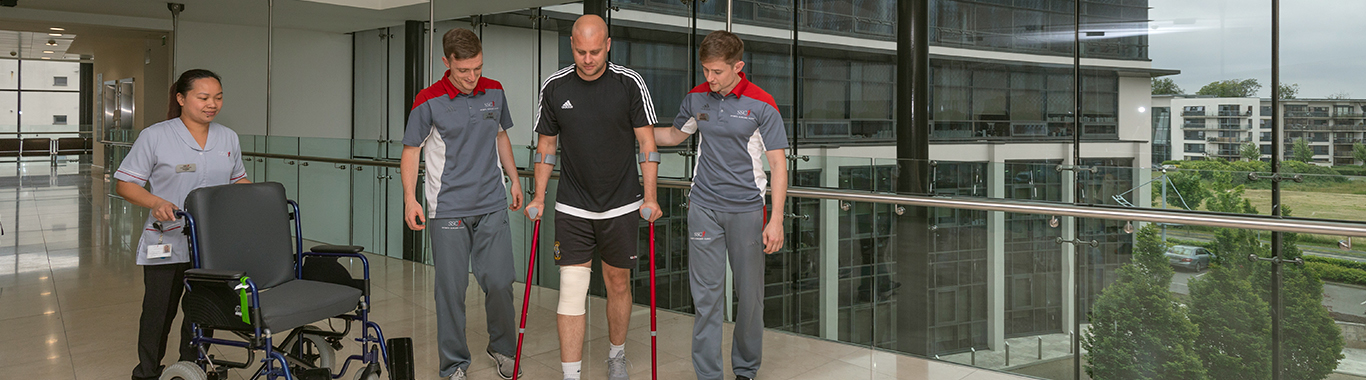

Hi, I am Hannan Mullett, I’m one of the shoulder surgeons here at the UPMC Sports Surgery Clinic and I’d like to talk to you today about some of the common shoulder problems.

Shoulder problems are very common and it ranks second only to back pain is the most common reason why people might lose work due to musculoskeletal problems, it can be due to someone’s occupation because they are involved in heavy lifting or more commonly nowadays, is that static posture or working at desks or in a fixed position for a long time. When you look at your shoulder problem on the Internet, you get bamboozled with all this information about different types of tests and different types of treatment, some of them are reliable types of treatments and some of them are not.

So I’m going to talk a little bit about the most common type of problems we see. For the non-injury type of shoulder problems, wear and tear type problems, the most common problems I see are problems with the rotator cuff. And this can go from somebody where the tendon is intact but rubbing against the overlying bone to people who have torn the rotator cuff. Another common problem is a frozen shoulder, which is common particularly in middle-aged women. Arthritis, probably not as common in the shoulder as is in the hip and knee, but it is a common cause of shoulder pain. I’m not going to really talk today much about sports injuries. It’s more about the wear and tear type of problems we see in the general population.

There are two main parts to the shoulder, the scapula or the shoulder blade and then the humorous, which is the arm bone and at the top of your shoulder you have the collarbones. The collarbone acts as a type of strut to hold the shoulder blade in position and then allow the ball and socket joint to move so that you can place your arm overhead. If we go to the next layer, if you like, in terms of the anatomy, we can see that the various muscles around the shoulder and the ones that cause us the most concern, really, are the rotator cuff muscles, which are a group of tendons around the ball and socket joint, the power of the shoulder and particularly the one at the top, the supraspinatus can impinge against the bone and cause pain.

In terms of the rotator cuff, the one that’s most commonly injured is the one at the top called the supraspinatus, which brings the arm out from the side and then the less commonly the infraspinatus, which brings the arm out from the body. These are commonly a source of inflammation and also, they can tear and need attention. In terms of the rotator cuff, it can go all the way from tendinitis or inflammation of the tendon all the way to a rotator cuff tear and then some patients who have rotator cuff tear, can then develop arthritis due to that tear. About 10 per cent of people with a major rotator cuff tear can get arthritis due to that tear. As to why some people just get tendonitis and some people it develops into a full tear, this can due to their age and more likely as you get older or if they’ve had an episode of trauma or maybe their occupation. But there is a strong genetic element as in a lot of things in life you can blame your parents!

When we look at the type of treatments, it really depends on how bad the condition is, we can start off with things like physiotherapy or injections are often very helpful, particularly if we want to avoid surgery in the earlier stages of treatment. Some rotator cuff problems are amenable to keyhole surgery. This can involve either taking away spurs of bone or in fact repairing the tendon. Some types of rotator cuff tears require open surgery, though this is becoming less common nowadays and then the ultimately small number of the overall patients who develop rotator cuff problems require shoulder replacement surgery.

One of the most common shoulder conditions is impingement. In this image, you can see this long bay structure is the humorous of the arm bone then they have the tendons or the rotator cuff. There is a fluid-filled sac called the bursa and as the patient raises their arm, they can get impingement or pressure on the rotator cuff on the Bursa as it rubs against the bone spur above it. And in fact, you can get this vicious cycle so that a patient gets a little bit of inflammation in the tendon, the tendon then becomes thicker and inflamed and then more likely to impinge and cause pain. This is what’s happening in this animation as the patient raises their arms. You can see the tendon impinges against the bone and the ligaments and this is what we see if we end up putting a camera into the shoulder. This is rotator cuff tendonitis. In fact, there’s a lot of terminologies that crosses over so if you get an MRI report showing rotator cuff tendinitis, that’s the same as impingement, which is generally the same as a partial thickness tear.

When you examine the patient, they as they raise their arm up in the air, they may be comfortable when they have their arm down one side and then when they raise their arm up in the air pinches and they get a positive impingement. When patients have a lot of shoulder pain and are sent by their General Practitioner or by the physio for an MRI scan they are often a little bit disappointed when the result comes back and shows in fact the rotator cuff is intact. Because when the MRI scan is done, you’re lying in this tube in the hospital with your arms down by your side, which is the most undemanding position for the rotator cuffs and it’s not very sensitive for looking at rotator cuff tendinitis.

It is useful in that it can distinguish from other shoulder problems like a full-thickness tear, rotator cuff or arthritis of the ball and socket joint but it doesn’t make the diagnosis you have to examine the patient and take the history of the story that they’re telling into the context as well as to what you’re going to do. So in terms of treatment, when somebody has a rotator cuff tendinitis, you tend to avoid aggravating factors, if you are a plasterer and you do a lot of overhead activity to try and minimise this there are some occupations particularly plasterers or hairdressers or people where you’re using your arm in a position that aggregates your rotator cuff.

It is reasonable to start off with anti-inflammatory medication for a few weeks. Physiotherapy is also very useful and I certainly would try physiotherapy, anti-inflammatories and simple things before moving on some more complicated things. If patients have had it generally for more than six weeks or sometimes if it’s very severe, one would think about a steroid injection but we don’t really like to inject the body unless you’ve tried everything else.

Generally, I avoid steroid injections and they’re very useful, but I try not to do it on patients unless they have had it for more than six week period. Exercises are useful, simple stretches such as standing and raising your shoulders, holding for five, seven seconds and then back down again, squeezing your shoulder blades together and holding five seconds, or putting your shoulder blades down and holding for five seconds is useful. These type of stretches, particularly if you have some stiffness when you’re lacking a little range of motion when you test it out doing simple exercises like this or stretches with your arm across your chest or event this one which you can do against a door frame – these are all useful rotator cuff stretching exercises, which you should do before seeking any medical attention.

So if you had you’ve tried the injection or you’ve tried the anti-inflammatories, you’ve tried the physiotherapy, it’s you’re still in trouble, you are getting night pain and pain at night then it is reasonable to try a steroid injection. This can be done fairly readily. It can either done by the radiologist or in fact, it’s a fairly large target that you’re injecting into this large bursa, so it’s very convenient for the patients to be injected in my office, which saves them coming back another time. This is said generally takes a couple of minutes to do. It is safe. There’s about a one in 10 chance that it’s a bit more painful for a day or two and about one in a thousand people, unfortunately, can get an infection from any injection. This is more common perhaps that they’re diabetics or other risk factors.

So in patients, the small number of patients require surgery. Here we are looking at the right shoulder from behind, the metallic instrument here is a shaver and I am using that to take away the thickened bursa and also in this part of the operation to take away spurs of bone that are impinging against the tendon. This can be performed as a day case surgery, it’s done through three very small 3mm incisions. The patient wears a sling for a number of days and generally, they can get back to normal activities, such as driving within that four or five days. Patients also have a small joint to the top of the shoulder between the collarbone and the other edge of the shoulder. This is not an important joint, but in everybody, 100 per cent of people, it gets worn as we age.

So, if you’re over 40, you get an MRI scan of your shoulder it’s definitely going to show the general change of the AC joint (acromioclavicular joint). In most patients, this is not a source of pain, but it can be.  If you have pain when you cross your chest and at the very extremes of movement, this is more in keeping with it AC joint type pain and this can also be injected and ultimately if it is giving enough trouble this can also be addressed through keyhole surgery. If you’re over 40 and you get your MRI scan results, it will always show degenerative changes of the AC joint and you may be told by somebody that you have arthritis in your shoulder. Well, the arthritis is in a very small part of the shoulder and it may be that the rest of the shoulder, in fact, is completely normal.

So what about when we move on then, we’ve spoken about it a little bit about the impingement and rotator cuff tendonitis and we’ve spoken about the general change of the AC joint. What about tears? There is an old adage that grey hair equals old tear, and certainly, as you get older, there’s a greater likelihood that you’re going to have a rotator cuff tear.

By the time you reach 80 years of age, 80% of people will have a rotator cuff tear, which doesn’t mean that we need to do anything with it unless it’s causing some symptoms. And generally, it’s important you can separate rotator cuff tears as to whether they’re an acute tear, i.e. due to, you lift something heavy or you fall or you trip over the dog and you have your normal shoulder and then you tear the rotator cuff as opposed to the kind of wear and tear type of rotator cuff problem, a degenerative rotator cuff tear. Generally, if somebody is fit and healthy and otherwise in good shape, if they tear the rotator cuff due to an injury, we tend to repair it. If they have a wear and tear type of rotator cuff problem, we try to treat it with tried physiotherapy and perhaps one or two injections. Rotator cuff tear are generally rare under the age of 40 but as we age, they become more prevalent and most patients over 70 will have some degenerative changes in their rotator cuff.

When you put a camera in the shoulder this is what it looks like, this is the edge of the bone here with a tendon should be attached and the rotator cuff has kind of pulled off the bone with a significant tear. This is a patient here so he raises the left arm without any difficulty and is having great difficulty raising his right arm and when he tries to bring his arm out from his side, even when we try and help him to bring it from his side it just flops back. This is a sign of a pretty severe rotator cuff tear. As to whether you repair it or not, we generally say with a wear and tear type of tear, we try and treat it with physiotherapy injections, first of all. But if somebody has a fall or an injury, we tend to try and repair it. And in fact, if you have a traumatic tear, i.e., due to an injury, you’re better off having it fixed sooner rather than later because the tissue tends to lose its elasticity and becomes more difficult to repair.

In most patients who come for intervention for their rotator cuff tears, the most common symptom is that they get pain at night. So they have difficulty lying on this side and it disturbs their sleep. To a lesser extent, they come with a weakness, for example, difficulty carrying a pot of tea or something with our arm outstretched or less commonly that the shoulder is unstable or pumping in and out, which is what happens really only with more extreme levels of rotator cuff tear.

It is important that the doctor or the physiotherapist usually starts by taking a history and an examination and then move on to the MRI scan rather than working from the MRI back because as I said if you’re 70 plus your MRI, is unlikely it’s going to show an intact rotator cuff. So we don’t treat the MRI we treat the patient initially. And this is what it looks like, this is when I put a camera into somebody’s shoulder. This is a right shoulder, and we are looking at it from behind. I am using an instrument to assess the white structure here is the rotator cuff. This was somebody who had fallen and I am just checking to see if we can repair the rotator cuff which thankfully we were able to do on this occasion.

Traditionally this was done openly and still, some people do it through an open technique. There’s nothing wrong with that except that it tends to be a little bit more painful that you need a more prolonged inpatient stay and the mobilisation is longer and you tend to get scarring between the various layers between the outer muscle and the rotator cuff and approximately 20 per cent of people with an open repair, will develop stiffness. As part of the repair, we take away the outer surface of the bone and clear out any scar tissue and then use special instruments to pass stitches or sutures through the rotator cuff, and then we tie these together, then put them into what we call an anchor, which attaches the rotator cuff to the bone.So the technology has certainly advanced even over the last five to 10 years, making this a lot easier to do and keyhole surgery, if it works well,  saves the patient a lot in terms of open surgery and here I have passed the sutures through the tendon and am now putting the anchor into the bone so that hopefully the patient will heal the tendon to the bone.

Next, I will talk about a very common problem called frozen shoulder. Generally, it happens between the age of 40 and 60. It is a bit more common in women than in men. People with diabetes and thyroid problems can get a more severe form.

There is generally no particular cause for it but it can happen after a minor injury. So somebody trips over the dog or trips over the curb, and within a few weeks their shoulder becomes painful and they put it down to the injury but it may just be the thing that triggered the frozen shoulder and in fact, you can develop a frozen shoulder after surgery. This could be shoulder surgery, for example, if you have your bone spurs removed in the first operation, I described a small percentage people can that can trigger a frozen shoulder or it can be triggered by it used to be quite common with open-heart surgery or a breast surgery in women. That can be cause for it. So what happens is there’s a thin membrane or a lining of the joint between the ball and socket joint and this becomes red and angry and thickened.

Patients present really with severe shoulder pain with a frozen shoulder, particularly if they overstretch. The Americans call it ‘jerk pain.’ So if they reach for somebody, they get searing pain. They also have significant night pain and sleep disturbance and then the shoulder becomes restricted, and they notice restricted range motion, for example, tying their bra. Luckily only get it once per side but if you get it on one side, you’ve at least 10 per cent chance of getting the other side. Generally, it takes nine to twelve months to resolve but it can be as long as two years.

There are three stages. The first stage is the most painful stage, usually will last four to six months. The shoulder is painful with restricted movement, pain at night, pain if you’re overstretched. The second stage, the pain gets better, but it still remains restricted and the third stage, it comes back to normal.

In the first stage, I often send patients for physiotherapy. Although physiotherapy for shoulders is generally a very good thing for stage one frozen shoulder, it tends to be too painful and it can actually just aggravate things to some extent. The Physio can help by mobilizing the neck and the shoulder blade but the ball and socket joint is too painful so in the first stage, taking painkillers can be helpful and I find, in fact, injecting the shoulder when somebody has a stage one frozen shoulder really helps the pain.

The second stage physiotherapy is more useful and the second and third stage, generally, the patient is much more comfortable and if they are happy in the knowledge that it’s going to get better over time, a lot of them do not need any further treatment. Probably about maybe 10 per cent of patients where it doesn’t improve within a satisfactory timeframe then we end up doing keyhole surgery. This is what I do in keyhole surgery. This is the right shoulder. We’re looking from behind the white structure to the right side of the field is the ball and I’m taking away all this very abnormal red, angry, inflamed and thickened tissue, which is the thickened capsule. which is the structure causing the frozen shoulder. This generally can be performed as day-case surgery as its relatively straightforward. The patient just uses a sling for a number of days and does a lot of physio after this to try and keep the movement.

Next, we move on to shoulder arthritis. You have probably had, or maybe your friends have had joints replaced such as hip or knee replacement. Shoulder replacement is not as common an operation, but it is the third most commonly performed surgery. Shoulder arthritis tends to occur at a slightly older age group, and as we survive longer, more and more shoulder replacements are being performed. In fact, the technology for shoulder replacement surgery has increased fairly dramatically over the last couple of years, so it’s a lot more successful.

This x-ray shows the normal ball and socket joint is very narrowed and there are lots of new bone formations called osteophytes, which is the cause of the problems. If the patient is suitable for it, we can do a lesser procedure where we don’t put long stems down the centre of the bone, we call it a stemless procedure. In fact its the operation I generally perform for this so we would cut the arthritic part of the bone away and then we take away a core of bone and then measure the distance between the cut surface and the outer edge of the bone and then we can put in the components.

The components are made and to accommodate for different sizes so that there’s an array of different supports plates called the trunnion. Then we advance this with what we call it a cage screw. It is a hollow screw that goes into the top part of the arm bone. Here we see the impaction of the metallic humeral head and this allows the preservation of the bone in case they need further surgery. The humeral head articulates with a plastic socket that is cemented into the shoulder blade. The other type of shoulder arthritis we see which is probably on the increase as people live longer and lead healthier lives is arthritis due to a significant rotator cuff tear. This generally occurs in people over 75 years of age.  This usually presents with an arm that’s painful, but the patient can’t really do their normal activities – even putting a key in the door can be trouble so they can lose their independence.

This is a different type of shoulder replacement where it’s called a reverse geometry shoulder replacement. So in this, you can see on the left side of the image there, we have the normal ball and socket joint and we replace this by putting a ball in the socket, under the socket and the arm bone, so we reverse the geometry of the shoulder replacement and this is done to allow us to take advantage of the fact that the outermost of the deltoid is intact so we restore what is called the fulcrum of the shoulder.

This is what it looks like on an x-ray. It’s a slightly more invasive surgery than the other type of shoulder replacement but, in fact, patients recover generally very reliably afterwards.  They wear a sling for four weeks, and often when they come back for their post-op visit, at four to six weeks, they have better movement, particularly in terms of raising their arms above the horizontal than they did before the operation. In fact, after they reverse geometry, shoulder replacement, the patients can, in fact, regain a range of motion and have a fairly comfortable shoulder in a very quick time frame.

For further information or to make an appointment with a Consultant Orthopaedic Surgeon, please contact [email protected]