image 027

Common Injuries in Rugby 7’s

Watch this video of Dr Stuart O’Flanagan, Consultant Sports & Exercise Medicine Physician at UPMC Sports Surgery Clinic and Leinster Rugby, presenting on ‘Common Injuries in Rugby7’s.’

This video was recorded as part of UPMC Sports Surgery Clinic’s online Public Information Meeting, focusing on Common Rugby Injuries, Causes and Prevention.
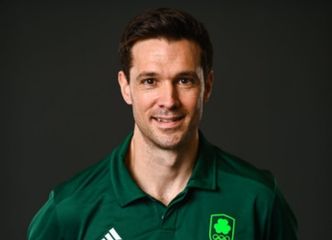
 

Web Dr Stuart O Flanagan Consultant Sports Medicine Physician 2022

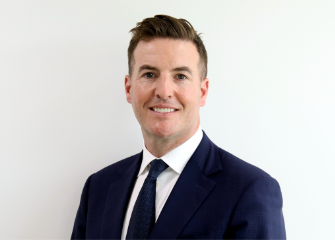
Dr Stuart O’Flanagan is a Consultant Sports & Exercise Medicine Physician at UPMC Sports Surgery Clinic and Leinster Rugby.

Good evening my name is Dr Stuart O’Flanagan and I’m delighted to speak to you this evening on this rugby themed webinar series. I’m going to be talking about Rugby 7s’ and some common injuries. It is a very exciting time for the men’s 15s’ as they start their world cup journey. For the first time were going to have two Irish rugby teams in the 7s’ competition competing in the Olympic games in Paris in 2024. I thought it would be good to share some insights into the programme there.

I will be going through an overview of Rugby 7s’, The IRFU National Sevens Programme, Common Injuries, Injury Prevention and also the approach we take here at UPMC SSC Sports Medicine.

Although played on the same size pitch and has the same size ball Rugby 7s’ is much more amenable and has many more similarities to other field sports like Gaelic Games and Soccer.

My background, I am a Consultant Sports and Exercise Medicine Physician here at UPMC Sports Surgery Clinic Sports Medicine. I also look after the medical side of the Irish National 7s’ team and I am also a Team Doctor with Leinster Rugby.

Rugby 7s’ is exactly how it seems. It has 7 players on a full-size field. The games consist of two 7-minute halves and typically a tournament will have 2-3 games in one day in a tournament which is usually over the course of a weekend. Typically, there are 3 forwards and 4 backs so a scrum will have 3 people in it as opposed to 8 in a 15 aside game and what that does is it provides a lot of space around the pitch for people to gain ground. It certainly rewards the people who are fast and athletic. Not only are they good at running in straight lines but they are also very good at changing direction, side-stepping, weaving through players. Speed, pace power and quick footwork are all highly rewarded in the game of 7s’.

The IRFU 7s’ programme was established a number of years ago and has rapidly evolved. They are now made up of 2 squads, Men’s and Women’s and they have about 20 players per squad. The majority of which are professionally contracted. They are based in the IRFU performance centre which is in the National Sports Campus in Abbottstown. The facilities are state of the art. There are 3 outdoor pitches. There is a half-sized indoor pitch to be used when the weather is less pleasant, they have a fully equipped gym, medical and recovery rooms, hydrotherapy pools, rooms for video analysis and a canteen with some full-time chefs who provide the players meals throughout the week. The players are here Monday – Friday and then travel all around the world to take part in 7s’ tournaments. Our two squads competed in the world series which has recently been rebranded and there is 8 venues across 5 continents. Men’s and Women’s competitions mirror each other. The competitions are played in exotic destinations like Dubai, Cape Town, Perth. North American venues such as Vancouver, LA. Asian venues such as Hong Kong and Singapore. Finishing in Madrid where the Men and Women will be competing in.

This year will be a very big year for our teams as mentioned as mentioned they have qualified for the Olympic Games in Paris in 2024. Our Women’s team qualified earlier in the year in Toulouse by finishing in the top 5 in the world series for the first time ever. Shortly followed by our Men’s team who qualified in Krakow in Poland through the European games earlier on in the Summer. It will be our Men’s second visit to an Olympics having qualified for the last Olympics in Tokyo which was played in July of 2021. I was very fortunate to have travelled over to that to a very different games during Covid-19 times where essentially all of the games were played behind closed doors. We have approximately 80% of our men’s team who have been to an Olympics along with our staff who have a lot of experience going into Paris it will be a huge experience for everyone.

I’m going to touch on the types of injuries that we see in 7s’ Rugby. While there are lots of similarities with the 15s’ game, this game is much faster, quicker and as I said rewards quick, powerful, evasive players and it’s all about finding space and avoiding contact.

The types of injuries that we see can be categorised into a few different areas. Contact Injuries vs Non-contact Injuries. Contact injuries occur in tackles and rooks. Whereas, Non-contact injuries are related to running and sprinting in particular which we will touch on shortly. Now let’s look at Injuries in relation to training and games. What is the type of injuries that happen in a training session and what are the types of injuries that happen in a game? Games are obviously a lot higher intensity due to the amount of running at high speed, much harder collisions and often the injuries in games can be related to contact situations. Then we often look at injuries in terms of incidence and severity so how many injuries of a certain type are we experiencing every year and how severe are they? We might have lots of muscle injuries that are keeping players out for a week or two but we might have more severe injuries such as a broken bone or a sprained joint which may even take longer. These are the kind of things we look at when we talk about injuries in 7s’ Rugby.

In the IRFU we perform and annual injury & illness surveillance and what that does is it helps us look back at the year just gone but also allows us to compare the years prior in terms of what kind of injuries we are receiving in our squads so is there trends that we can look at to try and reduce or prevent future injuries and are there things that we have addressed that have been issues in the past that we are now better at? In the last 12 months we have had a good overview of the Men and Women’s squads with some similar type injuries. The most common injury in training for Women is Ankle Sprains and the average time from injury to return to play is around 24 days. In games, calf injuries are the most common type of injury that we see and statistically players recover within 15 days. When we look at the Men’s side Hamstrings seem to be the most common injury that we have seen in training. The average time to return is about 27 days and in games which are more contact related injuries the most common injury we see is Ankle Sprains which statistically take about 25 days to recover. You can see that on average a player may be out for 3-4 weeks when sustaining an injury in a game and it tends to be the lower limbs so the joints and the muscles of the legs that have been impacted the most.

What are the most common causes of injury? I eluded to it previously, sprinting and high-speed running are really the big things and with less players on the pitch and with more space means more time is spent sprinting and running away from people and often those sprint efforts will be anywhere between 20 and 80 metres. They could be running the length of the pitch and they could be doing it repeatedly in the 14 minutes of the game that they are playing and Hamstrings are common across all sports especially field sports, Gaelic Games, Football and 7s’ is no different a lot of our players have previously been involved in Athletics and have done running so we are very well exposed to sprinting and running at the intensity at the World Series but Hamstrings still always tend to be one of the main issues. The Calf is another muscle injury which is more commonly found in the Women players this season but again for the same purpose and as well as the videos that I showed earlier, Jordan Conroy weaving in and out of players and changing direction is a big thing in 7s’. There is a lot of demand on the ankle as players sharply decelerate, change direction, side step and go again. That is certainly one of the reasons that we have seen a number of injuries to the ankle this year as well as the contact situations where players get caught up in tackles and their feet get planted in the ground, they are twisting and turning trying to get out of tackles where the ankle can roll or turn and be injured.

Treating Hamstring injuries is something that we are very familiar with and it is really important to have a good understanding of the anatomy and how the muscles work and in turn what the demands of the players are so we can treat the injury.

As you can see on the MRI scan this is what we use to diagnose injuries. It allows us to grade it between a 1,2&3 which allows us to determine when it is a player will be able to return. This gives us an indication of how hard or how quickly we can push an injury and also when they are going to be next available

Similarly, with the Calf a very important group of muscles the two Gastrocnemius muscles on the outside and the Deeper Soleus muscles all 3 equally as important as they combine and run into the Achilles Tendon and again we use modalities such as MRI to assess for injury to help us understand what the type of injury is but also what the timelines will be for the return to play for these athletes.

A big area of focus for us is on ankle stability and as you can see on the side of your screen there is a lot ligaments stabilising the ankle both on the inside and the outside as well as the top of the ankle and one type of injury we see more commonly in the last few years is a high ankle sprain also known as a Syndesmosis. Which is a ligamentous structure keeping the joint stable at the top of the ankle both at the front and the back and this is something we have seen probably more related to the surfaces that our players are playing on around the world in terms of harder pitches in warmer climates as well as some of the stadiums, particularly in North America they can be Baseball or NFL stadiums where the ground is artificial grass and the ground is harder and there is more impact going through the ankles.

In the 7s’ programme we put a lot of focus on prevention. My area of interest is more on preventing injuries rather than dealing with them initially. If we can prevent them coming, knowing what we know from the last 12 months or perhaps, maybe the last 36 months we can try and address that in the weekly schedule. Here is an example of a week for a player and this is all the work that they do outside of rugby. We often do quite a lot of work in the gym to prepare for pitch sessions. The focus would be on movement health so getting the spine and hamstrings warm and loose as well as getting the muscles around them active. We put a lot of focus on the shoulder as you could imagine because rugby tackling requires good shoulder health as well as putting some work into ankle balance, control and strengthening the muscles surrounding it. We put big emphasis on what we call posterior chain or hamstring and gluteal strength as well as neck strength which is something we use to help prevent concussions and this might be done on a couple of days during the week as you can see on the schedule. There is always preparation for training and playing but also preventing injuries based on what we have seen before and of course we also have the team approach but we also have the individual approach so some exercises will be very specific to a player and their injury history in particular. You can see an awful lot of work and thought goes into preparing a player during the week and this is an average week outside of tournament times.

The kind of things we look at are for the hamstring strength and the high-speed running. High speed running is the equivalent of a vaccine for our players in terms of hamstring injuries so we look to ensure they get a number of exposures where they are running at very high speeds. We constantly work on the strength of the hamstring and the muscles surrounding that and similarly in the calf the 3 muscles I mentioned we look at training them regularly with heel raises with a bent knee and a straight leg as well as sprinting and endurance running. Running volume is important for the calf and our players cover long distances repeatedly so it’s ensuring they have enough in the tank particularly when the intensity is very high and the temperature and humidity levels can be different also. As I mentioned, strength so you can see some jump testing in the bottom picture there where we are getting real stiffness into the ankle to allow players to withstand falls as they run jump and evade the opposition.

Our approach here at UPMC Sports Surgery Clinic is very similar. We look at any athlete that comes in and as I said a lot of the injuries that we see in 7s’ I see now on a daily basis particularly now at the moment as it is championship time in Gaelic and Hurling. Also, Soccer and Hockey we also get many from Athletics in at the moment as well and many of them have transitioned to 7s’ over the years. We look at the History thinking what has the injury been? Also, focus examination. We often utilise imaging such as MRI’s to make the diagnosis to allow us to understand what structures have been injured and also to give us an idea of the timeline. There is very big structures in the hamstring including muscle, fascia overlying the muscle and tendon which runs through and each of those has a different way managing and helping a player return to play often with strength and then running and indeed high-speed running in time before re-integrating into playing and training. We look at other measures such as strength, we do a lot of isokinetic dynamometry testing as you can see some strength testing of the thighs in that picture and we also look at jump testing as well as a measure of reactive strength. Ultimately, that culminates in a rehab plan for the athlete to allow them to return to sport. The aim here really is prevention trying to get them back once and for all and to reduce any risk of future injury as a result.

Ankle sprains are really common and this injury is probably the most common presentation of a joint injury that appears in an A&E clinic or a Physiotherapy clinic around the country.

The biggest predictor of a future ankle sprain is a previous ankle sprain so prevention is really key.

Once you manage the early stage of the sprain like the swelling and the pain, making sure that there is nothing more serious than physiotherapy is really important making sure we restore the balance of what we call proprioception and improving the strength of the muscles in the ankle which can drop off really quickly, particularly in the calf and the muscles around the gastrocnemius and gastrocsoleus which I mentioned in the talk are really critical for that and once you have got a good level of strength you can start turning to hopping and jumping and once that is all good you may return to running and move back into sports and specific drills.

In my perspective, prevention is the most important part because it is the most common injury and it is really about managing that well so you are robust enough to return to play sport or do any direction change in certain activities.

The big thing with that high-grade injury is that you have damaged all the ligaments. I’m guessing it is on the outside of the ankle, the lateral ligaments. It is the clinical assessment that is really important.

When you have that level of injuries you have the potential to have ankle instability and as I mentioned the thing that we want to prevent is recurrent sprains because you can get damage to the joint, the alignment and the cartilage. It’s really about trying to improve the balance, proprioception and making sure that the athlete feels stable and not vulnerable.

If all else fails then you should be looking at getting some help from foot and ankle orthopaedic colleagues and on occasion rehab doesn’t work out or the joint is not stable then we look at procedures to stabilise the joint using surgery. We try the best we can to see how well we can manage it and you would be surprised I have had capped rugby players and All-Ireland hurlers with really high-grade injuries who do very well but when you involve all 3 ligaments or even the ligament higher up the syndesmosis that’s more of a challenge and it all depends on the clinical picture and the assessment, function and reassessing it in short intervals.

There is quite a bit, even though the ball is the same shape and the same pitch the sports are quite different. As there is more space on the pitch in a 7s game that requires more running and also high-speed running.

Players tend to be lighter and quicker. There are heavier players but generally, they are like sprinters or track and field athletes. They have similar profiles to GAA athletes.

I remember a couple of years ago we had some players who came across from one of the 15 aside provincial teams and they did more high-speed running in a warmup for a training session than they had done in the whole season and that was measured on the GPS units that they wear on their back.

There is lots more running and lots more adaptations required to protect people from the likes of hamstring and calf injuries.

Hamstring strains and injuries are another big thing that we see a lot of in the clinic here and by the time they end up in my clinic. Often, they would maybe have 5 or 6 and often try to make their own return by trying some physio and rehab or sometimes they try to just take some rest, and the big thing is getting the diagnosis from the start.

We use MRI here quite often because it tells us what type of injury it is whether it is a muscle injury or if it is the tendon which runs through the muscle, and that gives you an idea of the timeline sometimes people injure because they come back too soon and sometimes there is no way of knowing without a clinical assessment or an MRI.

In general, the stronger the hamstring, and the muscles that support it around the hip and pelvis the more robust people are, but sprinting is also like a vaccination. In addition, if you are playing a sport where there is lots of high-speed running then you have to be strong but you also have to be used to running fast. They are all the things that we love to do to try and prevent injuries.

We worry a little bit less about flexibility its not really as important but if your muscles are ready for running and changing direction we can then work around hip mobility and movement around the back, and that’s the principle we take with things like strength, sprinting and then making sure you have the right diagnosis from the start.

For further information on this subject or to make an appointment, please contact [email protected]
Untitled 332 × 240px 2

‘Hiking / Hill Walking: Reducing the risk of injury’

Watch this video of David McCrea, Senior Musculoskeletal Physiotherapist, presenting on ‘Hiking / Hill Walking: reducing the risk of injury’.

This video was recorded as part of UPMC SSC’s Online Public Information Meeting focusing on ‘An Evening for Hikers/Walkers’.

Thanks, Fiona. Good evening everybody. My name is David McCrea, and I am a senior physiotherapist working at the SSC Sports Medicine department. I’m going to talk to you tonight about strategies that you can employ to reduce the risk of injury for walking Hill walking and hiking.

I just thought I’d start by actually looking at the gait cycle initially. It’s always good to have a good understanding of what is happening during the gait cycle and what the demands on our body are for this.

You can see here it’s broken down into a few different phases. The first two phases are really a phase where you’re trying to absorb energy. The heel strike where we made contact with the ground, and then we progress to a flat foot. During this phase, the muscles and tendons in the lower body are really trying to absorb the energy and stop our foot from just slapping hard onto the ground. Once we move into the next phase, which is the mid-stance and push-off phase in the middle here, this is when our muscles and tendons contract to generate some power to actually push us away from the ground and propel ourselves forward into the next step. Then finally, we have the swing phase, which is the final three diagrams here; this is when the leg is off the ground and what we have is the muscles in the hips lifting and bringing the foot into position for the next step. As a series of muscle contractions in different ways that happen time and time again as we walk further longer, and then this changes as we start to walk up and down hills.

Then I thought it would be a good idea to have a look at the anatomy of the foot and ankle in particular but have a look at the muscles and tendons that are responsible for allowing this movement to occur.

Here we have a diagram of the foot and ankle anatomy. We can see it’s a combination of bones which articulate with one another to form joints. Those joints are then held together by ligaments and then you can see the pink and white structures on the diagram; here are muscles and tendons; our muscles and tendons are what allow our joints to move.

Within the foot and ankle, we have quite a lot of muscles and tendons and all of them play a slightly different role during the gait cycle. We might touch on a few key muscles and what they do, and why they’re important.

The first one is the muscle at the front of our shin here called the tibialis anterior this is almost like an endurance muscle. When we hit the ground with our heel, this muscle is working hard to absorb that impact and stop our foot from just slapping onto the floor; with every step we take, this muscle is really working quite hard to control the movement.

On the inside of the ankle, we have a series of muscles and tendons that run into the foot here, called the tip post and the FHL. On the outside of the ankle here, we have almost the opposite called the perennials. These muscles are stability and control muscles; if you imagine you’re walking on an uneven surface, maybe that is sand, maybe you’re walking up and down hills with slightly uneven terrain underneath your feet, these muscles are working hard to contract and control the ankle. If these muscles are struggling to do so, we can often then end up rolling the ankle which is a common hill walking or hiking injury.

Finally then, at the back of the shin, we have our biggest set of muscles, which is the calf muscle group. These are the muscles that work hardest when we’re standing and walking and these are the muscles that are responsible for propelling us forward each step that we take.

When we get to the exercise session later on, I have some sample videos to try and target some of these key muscles because they are responsible for our movement, and they do work very hard when we hill walk or we walk for any sort of prolonged duration.

We mentioned that these muscles have different roles, and we also mentioned that they can work quite hard but I thought it’d be interesting to review and see how hard they actually work because walking is a task that we might take for granted because we do it every single day but when we walk for a prolonged period or when we walk up and down hills it is a taxing task on the lower body. There have been some interesting studies that try to quantify the loads and the demands and the different joints and muscle groups.

The first line you can see here quantified how much work is done at the ankle or how much body weight is absorbed in the ankle during walking on a flat surface, and this study showed that it can be up to five times your body weight every step that you take on a flat surface is exposed to the ankle joint.

If we shift our Focus higher up to the knee, we can see a similar pattern that the knee is responsible for absorbing two to three times an individual’s body weight when walking on a flat surface.

Now when we start to walk uphill or start to walk downhill, those forces can change and the contribution of different joints can change as well. For example, when we’re walking downhill, we place greater demands on our knees and our quadriceps muscles because on our way down a hill, the knees and the quadriceps absorb the force to slow us down and act like a brake system for the body. When we walk uphill, we have less work to do with the knee joint but we have more work to do at the ankle and at the hip joint. It requires more energy to propel ourselves up a hill, and the main movers for this are the calf muscle and the big muscles around the hip, like the glutes and the hamstrings.

Often what we’ll see in the clinic is that people get this balance slightly off. They’ll come in and they’ll have got the load they’re placing on their body a little bit too high, and their physical capacity is maybe not quite able to match that. An example of this might be that the demand they’re placing on their body in terms of walking volume is the same that they’ve always done. However, the ageing process is taking effect, so it’s taking them longer to recover between walks, they’re losing muscle strength and endurance and they’re maybe losing aerobic fitness.

What we might focus on next, then, is what, again, you can do from an exercise standpoint to keep yourself physically prepared for the amount of walking and hiking that you might be doing. We have a series of exercises here. There are six videos in total, and each of them is going to focus on a slightly different joint or a slightly different muscle group but they’re all the muscle groups that we discussed earlier that we know are going to work hard when we’re walking for any prolonged period.

These first two exercises are focused on calf muscle strength. The first exercise on the left here is a seated calf raise; we can see where you’re sitting on maybe a kitchen chair with your foot elevated onto a step or onto a book with a heavy weight on top of your knee; that is a 30-kilo kettlebell on top of Niall’s knee here and what we’re trying to achieve is that the calf muscle is responsible for driving that weight up and down.

On the right-hand side, we have a standing version of that exercise. You can see how this might closely mimic the demands of walking up and downhill. What we want to make sure of is that the calf muscle is primarily responsible for all of the movement here, and we’re minimizing the work done at the knee or higher up at the hip. We’re focusing on slow and controlled movements, making sure that the calf muscle is having to work hard to generate the power.

The second two sets of exercises focus on more of these smaller muscle groups that are responsible for stabilising the ankle and responsible for supporting the bottom of the foot. The first exercise here we have a single-leg balance exercise. This exercise is to try and place a demand on the muscles on either side of the ankle that play an important stability role; we can see here standing on something slightly unstable, this could be, for example, at home a cushion or a pillow, and we’re trying to create a little bit of instability and we’re trying to work the muscles either side of the ankle to maintain a neutral or a flat foot. On the right-hand side, here we have an exercise that’s designed to try and build strength and the muscles along the sole of the foot. We have a band tied around something like a bannister and then tie it around the top of the big toe. All of the weight is then on one leg and it’s up to the muscles along the sole of the foot to generate power to pull the band downwards; after 10 to 12 repetitions of this, we should start to feel muscles along the sole of the foot along the arch become fatigued.

If we were to shift our focus slightly away from the foot and ankle and move up the chain towards the knee, the quadricep muscles, and the hips for the hamstrings and glute muscles, we have two exercises here where you might get a lot of bang for your book. The first exercise is a split squat, so you try and split your feet apart and have an extra bit of weight over the front of your body like a kettlebell or a dumbbell, and what we’re trying to do is almost mimic the demands of walking downhill so we’re trying to go slow and controlled on the way down and make the quad muscle on the front of the leg work hard to control that motion and then we’re demanding that the quad muscles and the hip muscles drive us back up to the top.

The final exercise we have here is a hip thrust so that you can set yourself up with your shoulders on a couch, coffee table or a bench, all of the weight on one leg; what we’re trying to achieve is that the back pocket and the muscles in your backside are responsible for lifting you upwards towards the sky. After 10 to 12 repetitions of this, what we should start to feel is the back-pocket region starting to fatigue.

There we have six exercises which ultimately could be done probably in about 15 to 20 minutes. We’re focusing on the main muscle groups around the foot and ankle, main muscle groups around the knee and main muscle groups around the hip that are responsible for prolonged walking and responsible particularly for any sort of up and downhill walking.

A question we’ll often guess is how often I should do this and how much I should do it is better, and not necessarily the goal of these exercises is to progressively strengthen these muscle groups to help the joints that are working hard during walking. If you do these exercises every single day of week one, you might be eating into your recovery time between your walks and finding that you’re actually quite tired when you start your walks or two, you might be underdosing yourself a little bit, meaning that you’re not making the exercises hard enough to actually see the benefits of it so the way we tend to move now is we recommend that people do it on three days a week basis which could be every second day or every third day. For each exercise there, we’d recommend that you do three sets on the left leg and right leg, and then within each set, we’re looking to complete about eight to twelve repetitions as a guideline. When you reach your last repetition of each set, it’s important that you feel like the muscle that you’re targeting in the exercise is getting to a near-maximal fatigue state, meaning that if you hit your 12th repetition, it should be close to your limit, if you feel like you could go to 20 or 25 repetitions again you might be under-dosing the exercise meaning that it’s not challenging enough for you actually to get stronger. We would focus on three days per week, three sets for each exercise, and make sure the dose of the demand in that exercise is strong enough for you actually to see an improvement.

That is a brief overview of managing your risk of injury for any walking, hiking or hill walking. As you can see from today, it’s a combination of education around managing the demand you’re placing upon your lower body with your training and then making sure you’re meeting the physical capacity for that level of training. If you have any questions, I’m more than happy to answer them now in the Q&A session. If you’re interested in maybe getting assessed or working with a physiotherapist or a strength conditioning coach, the number for the sports medicine department is on the screen there and we are accepting referrals.

 What advice/recommendation would you give in terms of managing ongoing sciatica with walking or hill walking?

Yeah, that’s a good question. My main piece of advice initially, and I’m not sure if Dermot has already explored the sort of diagnostic side of things because sciatica is a term that’s used to refer to pain that stems from a specific nerve root. If he hasn’t had any investigations previously in terms of MRI scans, it could be a useful tool because, based on what’s found on the MRI scan, there could be different treatment options available to him to manage that. For example, if it was found on his MRI scan that there was a disc which was impinging the nerve route, sometimes an injection can be of benefit there to reduce pain and symptoms. The second thing then would be to; probably alludes a little bit to my presentation earlier on at having a look at what he can control in terms of his walking and hill walking level. For example, look at how often he is walking, how far he’s walking and what sort of terrains he’s walking on because those things are going to increase the demand on his body. He may or may not need an extra day or two between walks to be able to recover and then go again, so my main advice for him would try and get to the bottom of what’s causing sciatica in the first place. There might be different treatment options that are available off the back of that once you have a clear diagnosis and a clear cause, and then once you have that clear diagnosis and cause, maybe we look at the training variables in conjunction with a physiotherapy program to continue to manage this long term.

 ACL tear, seen orthopaedic consultant two months post-injury; not going to have surgeries discussed with the consultant as it’s not an unstable ACL but any advice on rehab?

Yeah, I mean, if you’ve already discussed and reviewed with your orthopaedic consultant and agreed that you’re going to go the conservative roof rather than the surgical route, that’s fine. The rehabilitation should largely look the same as the surgical route as well then. It’s something we see quite an awful lot of at SSC Sports Medicine. We have a huge amount of ACL injuries that come through our doors every year, and off the back of that, we’ve been able to develop a system for testing and rehabilitating these injuries, so might be our first protocol is maybe to look into attending SSC for a testing session, the information that comes from that testing session then can really inform what you need to focus on the most in your rehabilitation, and these could be things like improving your range of motion, improving your strength of key muscle groups around the knee and then also the stuff we discussed earlier on around managing the amount of load and training that you’re actually doing to keep the knee comfortable and keep the knee happy as well.

A lot of pain in the ball of my foot. I’m trying physio with lots of stretches of the toes and arches, but after six months still, I still have pain any advice?

Yeah, this is probably a common scenario that a lot of people end up and they come through our doors where they’ve been doing something for months and not really getting any success with it and it sounds like Mary is doing quite a lot of things for it in terms of stretching and different stuff but one thing that may be missing from that is maybe a strengthening component. For example, when we’re standing and when we’re walking, our foot is the first point of contact with the floor and it actually takes on a huge amount of strain and a huge amount of weight bearing and all of the stretchings in the world might not be able to help that it might actually need some strengthening exercises for the key muscles around the foot. The second thing I might say is if it’s pain around the ball of the foot, but again you’re maybe not exactly clear on what’s actually causing that pain, there might be a role here to see either a sports medicine doctor or a physio to help with the diagnosis piece because if you have the diagnosis correct, it helps you to manage or devise a management plan for it.

 Why do I suffer from shin splints when I walk fast?

Shin splints is a kind of umbrella term for pain around the Shins and it can be again a few different things. So, for example, it can be bone stress related, so it can be a bony stress response or even progressing sometimes to a Bone stress fracture; it can also be things that are maybe a tiny bit less sinister, like an overload of the tendon structures that stem from the shins this is often called tibial stress. First of all, again, I might go back to the idea of maybe being assessed by a physio or being assessed by a doctor to come up with a clear diagnosis because when you have that diagnosis correct, you can then decide what needs to be done to manage it. When we walk fast if you can see from my presentation earlier on, whenever we walk fast or whenever we walk up or down hills, the demand on the muscle groups and the tendon groups around the shin can really increase, so there may be a role here for strengthening the key muscles around the kind of lower part of the shin, foot and ankle region as well.

Are we going to upload copies of the leg exercises?

We are going to once this is over today and the whole webinar’s finished. We will have it on our website in the next few days, so you can go in and look at it at any time. Also, one of the tabs there is downloads exercises, so there are some exercises on there as well.

Any management for plantar fasciitis after hiking and how to avoid it?

Yeah, plantar fasciitis is essentially an overload of the plantar fascia where it inserts onto the inside aspect of the heel bone and it can vary a little bit; sometimes it can be an overload and an inflammation of those tissues, and sometimes it can be small micro-tearing that occurs in that region as well. Depending on what’s seen, maybe on diagnostic scans, there is a role for an injection followed by a period of offloading in a walker boot. If there are no tears, usually this is rehabilitated conservatively just through exercise and again, it might come back to trying to progressively strengthen the muscles around the foot and ankle as well as managing the amount of stress and strain all of the strengthening in the world might not help if you’re continuing to overload the structures and not allow them to actually settle down so it’s a little bit like the slide on my presentation today where you’re trying to manage the amount of strain you’re putting on it and you’re trying to maximize the amount of stress that these structures are going to undertake.

 A question from Judy she’s osteoarthritis in both knees and does exercises like lunging. Could she do squats instead? She’d find it difficult doing the lunging, or can you suggest an alternative to lunges?

Yeah, if you have osteoarthritis in any joints strengthening is one of the kinds of key cornerstones to managing that long-term, so it’s good that she’s trying to lunge and thinking about doing these things. Lunging is really an exercise to try and improve the strength of the Quad muscle at the front of your thigh and sometimes as well the glute muscles around your hip, so to an extent, it doesn’t necessarily matter massively what exercise you do as long as you’re able to engage and strengthen that muscle. If she finds, for example, squatting is a more comfortable alternative but allows her to strengthen her quad muscles, then that is a perfectly feasible sort of alternative to the lunge and I would have no issues with that.

I had surgery for a ruptured Achilles tendon in September. Do you have any advice on time scales for getting back into hiking and running, any advice on rehab?

Yeah, this is an area I see an awful lot of because my PhD is actually investigating Achilles tendon ruptures and how people get back to activity and sports following that. In terms of time scales, it can vary from person to person but in terms of getting back to running, I think a six-month time frame is a realistic time frame for most people that might be average and there are some people that are faster and there are some people that are slower than that. What I would put more value in is not necessarily the time that’s passing on the calendar. I put more value on the patient or the patient hitting key criteria that indicate they’re ready to run again, and that might be at four months, that might be at six months, it could be at eight months, but having key markers that indicate you’re actually ready to run again is what’s most important not necessarily the time scale.

How to avoid cramps after walking, or do you have any advice for tight calf muscles?

Yeah, cramps, to an extent, are a little bit unknown as to what causes them and what they really are. Years ago, it used to be tossed and it was dehydration or a lack of potassium and everyone was drinking water and eating bananas, but it really doesn’t make a huge difference; the current thought process around cramps is that it’s actually muscular fatigue so that the muscle cramps when it starts to reach a really fatigued state so if you’re cramping after your hill walk or you’re feeling really tight in your calf muscles after your hill walk it’s probably an indicator that these muscles have just undergone a huge amount of stress and strain and now they’re struggling to recover afterwards. If I were you, I would probably look at two things, one can I prepare my calf muscles a little bit better for my hill walking by doing maybe some exercises, and two, can I do things after my hill walk that makes me recover a little bit better so that might be for example eating, sleeping and drinking well enough to replenish the energy that I’ve lost on the hill walk.

 I have a question about the Achilles here from Brendan. He’s got problems with the Achilles tendon on his left foot. It comes on after a hill walk. It takes quite a long time to heal and remains either steen or sore. It can often reoccur after a few weeks, particularly after a challenging walk. Any other exercises or treatments that you would recommend?

Yeah, what Brendan’s describing sounds quite like an Achilles tendinopathy hard to say without meeting him and going into it, but it sounds like what’s called an Achilles tendinopathy, and this is when the Achilles has a painful response to the amount of strain that has been put upon it, and it usually presents after exercise and sometimes even 24 hours after exercise so the two key things for managing tendinopathy are managing the workload smartly. For example, if you know your tendon is struggling to tolerate a certain volume or intensity of walking, maybe try to reduce that a little bit to keep it happier and the second one then is to try and load the tendon using exercise, and that can be really guided by a physiotherapist.

What’s the best way to handle Morton’s Neuroma?

Morton’s neuroma essentially is an inflammation of a small nerve that runs through the metatarsal bones in the foot. There are conservative treatments which are, again, you can look at things like footwear, so there can be small changes in footwear which can make a big difference, or small inserts into footwear which can make a big difference. You can also use exercise as a way to try and alleviate that pain. There are slightly less conservative options as well where you can have injections and those injections usually are Guided by findings on an MRI scan or findings on an ultrasound, so you’ll probably have to see a sports medicine doctor to go there in that route they often work well in conjunction with one another.

Any kind of features or degree of support in walking or hiking shoes that are best to prevent injury?

Yeah, not necessarily in terms of preventing injury. A lot of research has gone into what type of footwear is best for hikers, walkers, and runners; in terms of preventing injury, no particular brand or no particular type of shoe seems to be the best or at the top of the pile. There are certain shoes that might be better suited to you and that depends on what activity you’re actually doing. It can depend a little bit on your foot shape and your foot type; an example might be if we go back to someone who’s dealing with an Achilles tendon issue. They tend to prefer a shoe that has a slightly higher heel in it compared to a flat shoe because the higher heel takes a little strain off the tendon when they’re walking, so there’s no brand or type necessarily; there might be a certain type that suits you a little bit better or your current injury.

Follow-up question on running after Achilles tendon rupture surgery. You mentioned key markers to indicate progress. Can you give examples of those markers?

Yeah, some of the key markers would relate to, for example, flexibility and mobility; another key marker would be around calf muscles, strength in calf muscles, endurance and then finally, we’d put some value as well in what we call reactive strength which is really almost like a power measure where you’re using the calf and the Achilles a little bit faster and more explosively, and that would paint a picture then that the Achilles and the ankle are ready to tolerate running again rather than kind of I suppose rolling the dice and hoping for the best and that’s something I see personally a lot of in the sports medicine department and we have the testing infrastructure available if he was interested in coming in.

A question from Deirdre she still gets pain six months after losing crutches. She got a screw fixation for her fifth metatarsal, where she had a break. She did physio religiously for three months once losing the crutches at the start. Should she double down and get back to exercise if she’s still in pain? She was in a boot for three months prior to surgery, so it sounds like six months she’s been in the boot and trying to do physio. What would you suggest?

I think those fractures at the base of the fifth metatarsal can be really tricky, so that’s not an uncommon scenario Deirdre finds herself in. The main thing would be guided by her orthopaedic surgeon that they’re satisfied with the healing and they’re satisfied with the actual fixation of the break itself and then definitely when you’ve been in a boot for three months prior to surgery six months in total what happens is the foot becomes sort of used to not having to weight bear a whole lot and so you lose things like muscles strength even the bone strength can be compromised a little bit because it hasn’t had that weight-bearing stimulus so exercise really is your sort of key to getting back to your normal life there in terms of bone health in terms of strength and muscle health as well so I’ve definitely look to start your rehabilitation again if you’ve stopped but maybe be guided by a physio through this process again.

Any tips for recovery after a long hike? I think you did speak about hydration, but anything else, David, before we sign off?

Yeah, I think the big thing when it comes to recovery the main one is sleep. Sleep is where the body really recovers and repairs itself, so make sure you’re getting good quality sleep. Secondly would be your hydration and your nutrition, making sure you’re replenishing the kind of energy that you’ve spent on the hike itself, and then you can look at other sorts of, I suppose we call them adjuncts to help, which might be things like foam rolling, stretching, massage and all these other things but it’s hard to do those things if you’re not sleeping, eating and drinking well enough in the first place.


For further information, please email [email protected]
Evening for Hikers Image 1 2

‘Summer & the living is easy! Staying on track with Knee Arthritis’

Watch this video of  Professor Brian M Devitt, Consultant Orthopaedic Surgeon specialising in the Knee, Presenting on ‘Summer & the living is easy! Staying on track with Knee Arthritis’.

This video was recorded as part of UPMC SSC’s Online Public Information Meeting, focusing on ‘An Evening for Hikers/Walkers’.

Untitled design 16.png

Brian Devitt is an internationally trained orthopaedic surgeon with subspecialty expertise in knee surgery. He is particularly interested in sporting injuries, including anterior cruciate ligament (ACL) reconstruction, meniscal repair, cartilage restoration procedures, multi-ligamentous knee reconstruction and hamstring repair. In addition, he cares for patients with degenerative conditions, such as knee arthritis, and performs partial and total knee replacements and osteotomies.

Brian completed his medical school training at University College Dublin, Ireland, and carried out his specialist training in Trauma & Orthopaedics at the Royal College of Surgeons in Ireland. He also achieved a Masters in Sports and Exercise Medicine. Brian pursued a career in academic orthopaedic sports surgery and completed three years of fellowship training. The first year was a research fellowship at the Steadman Philippon Research Institute. He then completed a clinical fellowship in sports surgery at the University of Toronto. Finally, he completed two clinical fellowships in Melbourne; the first was a knee reconstruction fellowship at OrthoSport Victoria (OSV) and the second at Hip Arthroscopy Australia. Following his fellowship, Brian worked as a consultant orthopaedic surgeon at OSV and Epworth Healthcare.

Brian has a keen research interest and is a Full Professor and Chair of Orthopaedics and Surgical Biomechanics at Dublin City University. He has extensive research experience focusing on clinical outcomes and biomechanical studies. He has published widely and frequently speaks at national and international meetings.

Good evening. My name is Brian Devitt, I’m going to speak to you about staying on track with knee osteoarthritis, and this is with relevance to walking and hiking. I want to first off show you a picture of a former patient of mine. This is a lady who’s in her seventies, and she has embarked on a charity walk in Vietnam; she had previously had a total knee replacement eighteen months ago, so there are a few features I just want to point out first of all if she’s smiling! She’s doing very well following her knee replacement; secondly, she’s using a stick to help her get up what is a relatively steep slope; she’s wearing the appropriate shoe wear she doesn’t have too much to encumber her in her hike in terms of carrying a lot of load, and she’s willing to help or receive help from the tour guide who’s bringing us along so when in Vietnam we learned an awful lot of things but one of the most important things we learned to some of the quotes from Confucius who is a Chinese philosopher, and he told us it doesn’t matter how slow you go as long as you don’t stop I think this is hugely relevant when it comes to the management of knee arthritis but also activity in the setting of arthritis it’s really important that we keep on going.

We all come in different shapes and sizes, and it’s the same with respect to our needs. We look here on the left side of the screen we see what a normal alignment, just two straight legs is; we see various alignments of what we know as bow-legged and common pylons, and we also see knock knees or valgus alignment where on the right-hand side of the screen now all the people who come in this in these different shapes normally but when it comes to pathology we also see people develop these shapes of their knees as time goes on and this is quite relevant in terms of how the ways when we walk goes through our knees when we’re in a neutral position the weight goes directly in the middle of the knee which is equally shared in this bow leg position the way it goes on the inside of the knee and in this knock knee position the weight goes on the outside of the knee so this has an impact in terms of how we progress with wear and tear as Life Goes On.

I’m going to show you a few picture examples or X-ray examples, and one of the things we use as orthopaedic surgeons to diagnose arthritis it’s key to take the history from the patient as to where the pain is and when it occurs, but an x-ray is very helpful the most important thing about the x-rays the person is standing, and we can see on both legs here that there’s very little space on the inside of the joint both of the right leg and of the left leg and we refer to this as decreased joint space or also what is known as bone on bone osteoarthritis so this happens in a situation where someone has bowed legs we also look at the kneecap, and that’s really important when it comes to walking because as you walk down the hills or down stairs or even upstairs it puts a huge amount of stress through your kneecap so it’s really important that we would look at this and this kneecap is not too bad it’s got a little bit of decreased space, but there’s plenty of life left in that yet.

We often get patients referred to us with an MRI scan and MRIs will diagnose a lot of the soft tissue conditions but we can also see arthritis so I’m going to explain initially we’re looking at this MRI looking at your knee from the front so this here is your kneecap I’m going to work our way towards the back anything that shows up as white on these scans indicates fluid or increased stress within the bone I’m going to point that out as we go so we’ll work our way back through the MRI it’s a little bit shaky so excuse me and I’m looking at the fluid in these we know that this knee is not in a great state and we can see that the bone in this area on the inside of the knee is very white and that indicates that this bone is under a huge amount of stress and the reason it’s under stress and I’m going to go through that again is because the meniscus which is a shock absorber in the knee has been damaged so you see this black structure is the meniscus and you see it’s being put down to the side of the knee and underneath you’ve no cartilage on this inside of the knee and that’s why a lot of people come to us to think they have a meniscal tear but in fact the horse has long since bolted its arthritis is the situation so this is how we see it on an MRI and the previous x-ray that we saw where your bone and Bone arthritis is how we see it on an X-ray so we do use all of these modalities to diagnose the injury and the presence of arthritis .This is another x-ray which shows arthritis not on the inside of the knee like previously but on the outside you can see the shape of the leg is different from the normal leg which is nice and straight we see on the outside of the knee you have wear and tear here with extra bone forming here in this region here and you can see there’s bone and Bone arthritis on the outside of the knee we look at this example of the kneecap we see that there’s a lot of extra bone around the kneecap and no space between the front of the kneecap and the femur so this is an example of someone who has not only wear and tear on the outside of the knee but also wear and tear on the front of the knee so you imagine they’re going to have an awful lot of pain walking down stairs kneeling or any type of movement going from a seated to a standing position.

Now we’re going to have a little bit of physics to understand why we have pain in the knee when we have arthritis and we walk and physics so this is a pictorial example of Isaac Newton so Isaac Newton discovered gravity but he also discovered a lot of other important physics and equations and theories and one of the things that he recognised is that gravity is a huge part to play but also within the knee as we expect we extrapolate that to the load going through our knees when we walk it is very important so if we look of just walking the weight that goes through our knees each individually when we walk is twice our body weight when we walk downhill that increases to four times our body weight and if we were to run that can go up to as much as eight times our body weight so that’s why if someone might be fine while standing but when they walk the pain increases it’s because the load going through the knee also increases so let’s do a small little calculation so we’ll take a hundred kilogram male so that’s a big man may be carrying a bit of extra timber so 100 kilograms that person walks down here 400 kilograms goes to each individual knee with that action now if he was to lose a moderate amount of weight which is ten kilograms or ten percent of his body weight which would take a bit of effort he would find that forty kilograms less goes through each knee as he walks downhill so this is a very important to remember in terms of the loads that go through our knees when we walk and also as a means of treatment for arthritis it’s very important.

In terms of the injuries we get while walking, I’m going to give you a couple of examples of how to avoid injury, to begin with, so you don’t end up in my office at any time. So first of all, it is knowing your limits so when you start walking or if you’ve gone from a period of sedentary period to an active period, it’s important that you go gradually; you don’t go start hiking Mount Everest when you’re just starting you’re walking so it’s very important to know your limits I think that’s one of the things we saw after covet is when people were relatively sedentary they went out to walk every day of the week we saw people with a lot of issues developed quite quickly so if you’re starting to walk just start walking on the flat first and if you want to then engage in some steps that are appropriate if you have no pain or then walk up and down Hills as you see fit. it’s often best to be preconditioned so you want to improve your ankle strength and balance and nowadays we recognise that Pilates is really a great treatment for all types of ailments and it’s incredibly important with regard to improving your core strength but also the strength of your quadriceps and hamstrings and also your ankles if you’re particularly when you see reformer Pilates these can be very effective as an all-around holistic method to improve your strength and balance we recognise hugely as I saw in the picture at the start is that the use of hiking poles is really important particularly when you’re going up and down hills because it allows you to take the load off the front of the knee and share it with the load in your arms it also gives you an improved workout with your upper body so using more walking poles is actually very sensible when it comes to hiking so that’s something we would recommend very much so the use of appropriate Footwear so going hiking in a pair of sandals is not appropriate because you’ll end up rolling your ankle or you’ll load inappropriately particularly on uneven ground and that tends to put increased stress through your knees or a little needle there are some blisters that you’ll try to you’ll walk a bit more you walk differently and that puts increased load through your knees so that’s it and not a good wise thing to do is to wear inappropriate Footwear and we recognise wearing properly fitted Footwear with appropriate socks and trying to avoid getting the likes of blisters because they do change the your gait and it’s important that you try to maintain a normal gait that you equally distribute the weight throughout your knee and not in one certain area and then just common sense and  hydrate adequately when you’re tired of fatigue you tend to stress our knees quite a bit more so just have an appropriately distant walk so you’re not very fatigued at the end of it or you’re walking in incorrectly which puts more stress to the front of your knees it’s really important that your general health is well maintained as well .

Let’s just look at arthritis unfortunately if you can’t avoid injuries and you do get some injuries or arthritis how do we manage them it’s really important that you understand this so I like this quote from Macbeth I’ve used it before in different talks where it says ‘ Eye of newt and toe of frog, Wool of bat and tongue of dog, Adder’s fork and blind-worm’s sting, Lizard’s leg and owlet’s wing, For a charm of powerful trouble, Like a hell-broth boil and bubble’ if we got the lighting to come on as well give it a bit more impact but this is a quote from Macbeth but none of these things work for osteoarthritis you can rest assured you don’t have to have any far-fangled poisons or potions to get you to improve your arthritis these things don’t work I oftentimes get patients coming into my room and they’ve consulted Dr Google and they come in and say well this laser work doctor and really I try to keep it very simple there’s a few tried and trusted things that work for arthritis and I would encourage you to follow the trial and trust it and not the far angle treatment so these are the treatments that do work so physical activity is important just like the lady who’s walking after a knee replaced and walking beforehand can be effective but we try to avoid heavy load activities that put more stress to our knees weight loss is really they’re probably one of the best treatments but it’s not an immediate treatment to lose weight so weight loss is very helpful as per Isaac Newton’s knowledge and equations earlier on acupuncture has not been shown to work massage can be helpful for tight muscles bracing can occasionally be helpful and maybe a compressive brace can give you a bit more feedback in your knee in Soles likewise have not been shown to be hugely helpful but they do make footwear fit more appropriately and glucosamine has not been shown to be extremely helpful but it doesn’t do much harm and it’s cheap so I wouldn’t be overly against the use of glucosamine as an oral tablet.

We then look at pharmacological treatment and we recognise that anti-inflammatories do work so if you have swelling in your knee it shuts down your muscles so if we can get rid of that swelling it allows your knee to function much better a steroid injection and can be helpful particularly if you have swelling but it’s not it’s not a long lasting effect it just has a short-term effect the use of hyaluronic acid in this recommendation and that’s from the American Academy of orthopaedic surgery has not been shown to be effective it may be more effective in younger patients but not in patients with Bone arthritis and then plated rich plasma can be helped in some circumstances but it’s not the go-to in every case and then we look at surgeries and what stuff that we do as a surgeon so washing the joint out with the camera that is not effective it used to be an old-fashioned treatment but we don’t do that anymore sometimes if people even in the setting arthritis have a flipped piece of soft tissue like meniscus remove that can give them and some temporary relief but it doesn’t remove the arthritis it just removes the soft tissue which might be impinging or getting in the way, doing an osteotomy which means cutting the bone and changing the shape of the leg can be helpful in certain cases and then a joint replacement has been shown to be very effective in the right setting at the right time so, one of the take-home messages I always say to patients is your objective is to avoid people like me as long as you can.

When your arthritis gets quite severe we are very helpful in terms of believing that pain and getting you back on track so the effective method just to reiterate our weight loss modify your activity if you’re doing things that are hurting you a lot like walking down stairs or and you know walking down slopes then I try to avoid that as best you can and it’s also important to maintain the strength of your of your muscles and do so in a manner that doesn’t hurt you so much so doing the likes of cycling swimming if you have advanced arthritis can be very good to maintain your motion the use of anti-inflammatory medication is very important there’s a limited role for arthroscopy and knee replacement when ready and when I tell patients they know they’re ready when they pain at night or pain at rest that really affects the quality of life and that’s where it’s really important so I’m just going to give an example of this is a knee replacement so this is one of the ladies earlier on who had the wear and tear to the outside of the joint and the front of the knee and this is what we did we gave her a knee replacement and this lady was back walking and hiking and it’s not quite the picture of the woman I saw at the front but very similar back to a very active quality of life we see how straight we get the leg afterwards and this is replacing the kneecaps that was extremely badly worn with a resurfacing of that kneecap or patella as we talk about so allowed her to walk downstairs without any major problems we also sometimes just replace one part of the joint so on this right leg here we see the inside part of the joint has arthritis and decreased joint space and extra bone here and in this case we just replaced this side because the rest of the side was relatively well maintained and allows patients to get back to a very good level of function very quickly after surgery so patients often ask me how active can I be with a knee replacement and I often remember a patient of mine who is a farmer from an area in Victoria when he’s working Australia called Gippsland and I remember this patient came in and he came at six months following surgery and he asked him that his knee hurt and he said occasionally it hurt I said when does it hurt he said well after shearing 50 sheep it became a little bit painful and he told me a very good quote which I often tell patients when I see them in the clinic and what this said he said was I quickly realised that it was a case of my knee getting used to me and not me getting used to my knee so this is a real paradigm shift in my mind in that when you have a knee replacement just go off and do what you want to do if you Molly coddle that knee and if you don’t move it you’ll be storing sore and stiff you could off and do what you want to do whether it’s um cycling whether it’s playing tennis whether it’s surfing whether it’s shearing sheep just do what you want to do and your knee will follow suit so I’m very happy to take some questions later on and I hope you get back on track with knee arthritis .

Well, it’s quite common to guess growing pain while walking. I suppose it depends on the patient’s age, but typically if someone has pain, it’s either a muscular injury or strain or can relate to arthritis. It’s a very common site to get arthritis within the groin, and it’s typically a pain that comes on after exercise as it gets more severe. You can get it at rest or at night, and that’s when you really should have something done about it.

Yeah, a walking stick can be very helpful. Essentially it’s typically used in the opposite hand and essentially offloads some of the weight going through the hip, and the muscles that are attached to the side of your hip really undergo quite a bit of stress when you have arthritis because the joint is irritable and this is an ability to offload that by using the walking stick around the opposite hand typically.

Yeah, for the same reason walking forwards are an excellent idea, and people tend to use two poles nowadays. I know the picture I showed at the start of my talk was just the solitary pole, but she used two poles. I think they refer to it as Nordic  walking, and where they use two folds is great because you’re able to particularly going uphill but also going downhill, you’re able to take some of the load off the front of the knee, so you use your arms to push you up and keep the stick and quite vertical, and it allows you to exercise your upper body but also offload the knee and takes a lot of the stress off the front of the knee and makes it somewhat easier

Well, as I referred to with Isaac Newton and the importance of gravity and weight are hugely important in terms of the load going through a joint, so, not just your knee joint but all your joints of your body, so if you’re carrying excess weight, you will put a significant amount of weight multiple times your weight through that joint and in terms of excess ways and inflammation I think the excess load is going to give rise to further inflammation within your joint, and I know there are further studies that probably have looked at obesity and inflammation in general but specifically with the joint it’s very much the load that goes through the joint causes the irritability.

The new support can be helpful in certain circumstances. I think you know you can go from very fancy braces, which offload one particular compartment of the knee and they can be somewhat awkward to wear but can be effective, to a simple sleeve which essentially can give some feedback or what we call proprioception is where you know knowing where your joint is in space and sometimes you have swelling in the knee using a compression sleeve is very effective and but there is no proven evidence that they’re going to reduce the progression of arthritis they just make you feel a bit better during exercise sometimes.

I just think we’re not there yet. I think, realistically, stem cells offer a great possibility, perhaps in terms of the management of arthritis, but we really don’t have the answers yet. I follow the research quite closely on this issue, and really we don’t have the evidence to support the use of stem cells. One of the things which are very interesting is some of the guidelines from Australia, where I worked previously; they said you shouldn’t really be involved or go to someone who is delivering stem cells without it being involved in a randomised control trial, and you’ll find that most of the people who supply stem cells are doing so too for a commercial gain it’s not based on research or evidence so I would say beware in those circumstances because you can find yourself out of pocket a lot without any proven evidence it works.

Golf BAck Pain

‘Management of Common Golf Related Injuries’

Watch this video of Dr Ronan Kearney, Consultant in Sports & Exercise Medicine, “Management of Common Golf Related Injuries”

This video was recorded as part of SSC’s Online Public Information Meeting, focusing on ‘An Evening for Golfers’

Dr Ronan Kearney Consultant Sports Medicine Physician


Dr Ronan Kearney [FFSEM, MFSEM (UK), MB, BCh, BAO, MICGP, MSc (SEM), Dip (MSK, FIFA, Occ. H)] is a Consultant Sports and Exercise Medicine Physician at the UPMC Sports Surgery Clinic, Dublin alongside sporting roles with Sport Ireland Institute, European Tour Golf and Louth GAA.

He completed undergraduate medical training at the Royal College of Surgeons Ireland. After working across a number of Orthopaedic and Emergency Medicine roles in Ireland and Australia, he completed an MSc in Sports and Exercise Medicine at Trinity College Dublin. Subsequently, he undertook General Practice training at RCSI/Dublin before completing Higher Specialist Training in Sports and Exercise Medicine with the Faculty of Sports and Exercise Medicine (RCSI/RCPI).

Dr Kearney has worked as Team Doctor across a number of sports, including Soccer (Rep. of Ireland Men’s U18, U21, Rep. of Ireland Women’s U16, Women’s National Senior Team, Shamrock Rovers FC), Rugby (Trinity Rugby, Easts Rugby Union Brisbane), GAA (Louth GAA, Castlebar Mitchells), Athletics (Sport Ireland Institute, Dublin Marathon Series) and Rowing (Commercial Rowing Club Dublin). He has also been an Expedition Doctor on Mount Kilimanjaro and has worked as Medical Officer at multiple European Tour golf events.

He is an Associate Editor for the BMJ Open Sport and Exercise Medicine Journal, having previously held the role of Lead Author for Education from other Journals sections of the British Journal of Sports Medicine. He is a Sports and Exercise Medicine lecturer to the MSc Sports and Exercise Medicine (Trinity College Dublin) and Paramedic Studies (University of Limerick) postgraduate courses. He is Chairman of the Gaelic Athletic Medical Association, Secretary of the Football Association of Ireland Medical Committee as well a member of the Irish Society of Lifestyle Medicine and FSEM Education Committee.

My name is Ronan Kearney, and I’m a Sports and Exercise Medicine Consultant in the UPMC Sports Surgery Clinic. As we know, the UPMC Sports Surgery Clinic is made up of the main hospital as well as the Sports Medicine Department about 100 metres up the road. In that Sports Medicine Department, we have a number of consultation rooms, an injection room, a high-tech gym and rehabilitation facilities, and we’re lucky enough to have a full multi-disciplinary team with both Sports Medicine Consultants, specialist Physiotherapists, strength & conditioning coaches and player mechanisms all working together with our radiology colleagues in the main hospital.

Outside of the UPMC Sports Surgery Clinic, I’m lucky enough to work with a number of sports. I’ve worked in Golf both on the DP World Tour as well as the Legends Tour. I also work in GAA and the high-performance units in the Sports Institute Ireland, mainly with athletics preparing for Paris 2024.

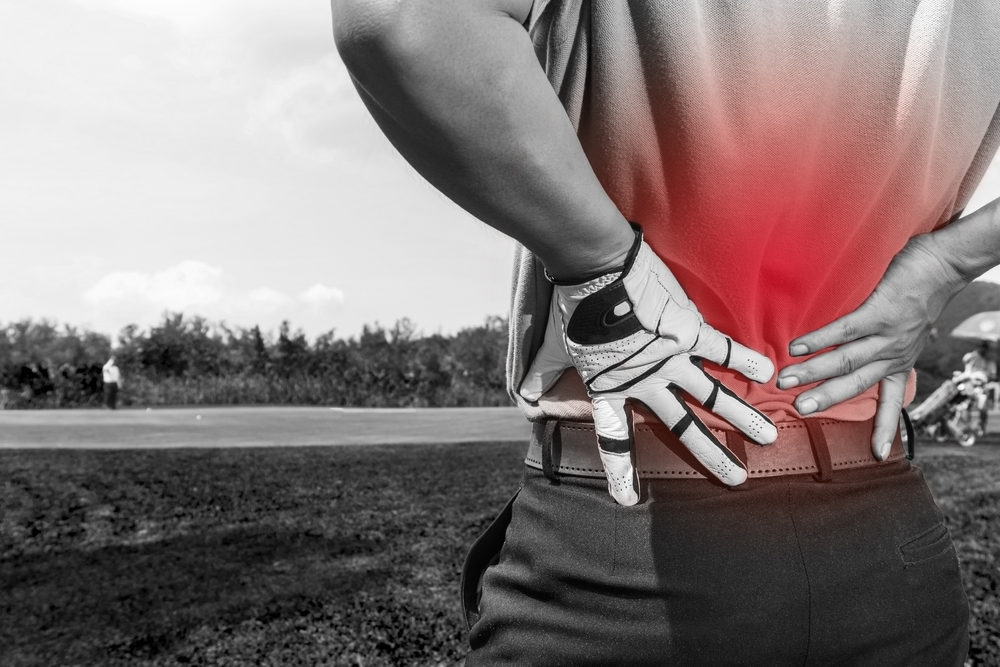
Working in golf is very rewarding, and I hope I have learnt some things working in the league of golf that I can apply to the recreational golfer also. Today we’ll speak on a number of different golf-related injuries. It is first important to understand some of the basic biomechanics in the golf scene that relates to injury, as oftentimes, injuries are a result of biomechanics. Lower back pain is the most common golfing injury in both recreational and professional golfers, followed by the shoulder and elbow.

Firstly the golf swing is biomechanically fascinating in many ways; it is so impressive to see a top golfer show the control, coordination, power and precision to hit the ball. It is made up of a number of stretch-shortening cycles of muscle contractions. These are an important chain of events, with each cog in the wheel providing an important role, trying to ensure that the little white ball goes to the intended target. It is important to note that any weak link in the chain can have knock-on effects which can lead to either injury or, eventually, poor performance.

At each stage in the golf swing, there are different groups of muscles working in different ways. Not to get too bogged down by the different muscle groups, but if one or some of these groups are not working as normal for whatever reason, there can be knock-on effects that can lead to problems.

To give a background on the three more common mechanics in golfing that you might hear is the X-factor, Crunch Factor and Reverse- C we will speak a little more about this in the lower back section, but the X-Factor is a really a separation between the upper trunk and the pelvis at the backswing and during the downswing seen in figure A here. The Crunch Factor is a combination of the lateral complexion and axial angular velocity that impacts an early follow-through seen in the middle picture here. Reverse-C is the follow-through and trunk hyperextension; we will come back to that a little later.

Lower back pain in golf is very common; almost a third of amateurs and over half of professional golfers suffer from lower back pain at some stage. There are a number of factors that lead to back pain in golf; some are non-modifiable ones that we can’t change. Unfortunately, increasing age leads to an increased risk of lower back pain. If you have previously had episodes of Lower back pain in the past, you are more likely to have future episodes, and unfortunately, if you are male, you are more likely to have lower back pain also.

These are the modifiable risk factors for lower back pain in golf, and these are the factors that can be changed. This is where management can help. We know that BMI is where obese people or overweight, which leads to an increased risk of lower back pain,  poor strength, flexibility and coordination can also lead to lower back pain in golf. We will come to this a little bit later. Swing biomechanics play a role, and interestingly enough, a study has shown carrying a bag can increase the risk of lower back pain also. Back to the swing again, the swing is a repetitive motion with large angular velocities and loading force that is placed on the spine. We know the distance off the tee is associated with lower scores, and in professional games, it’s associated with higher earnings which many golfers are really trying to push for.

As a result, there has been an increase in golfers trying to adopt a modern swing technique, and there is much debate in golf, as you would all know about which swing is better. There is no right or wrong answer here in my eyes, and everyone is to be treated on an individual basis anyways. We know that generating more power and speed is associated with greater distance, but this can come at a cost; if the biomechanics or strength and conditioning are not right, this can lead to problems.

These are three different types of swing biomechanics that have been associated with lower back pain. An early extension where the hips come forward into the hand space as seen in the first box below, reverse C, which is at the end of follow through, which we get an increased lumbar extension and then a reverse back spine angle at the end of a back swing where again we see an overextension of the lumbar spine on the left-hand side. Overextension on the right-hand side suggests a crack spine angle, and again, this has been suggested in the literature.

With regards to swing biomechanics, a large review of biomechanics and lower back pain suggested that a number of factors in the swing can lead to lower back pain, I don’t want to get too technical here, but some are shown on the screen. The important part here is such mechanics are important to be identified, and those struggling with back pain are to work closely with their golf professional or coach to address these issues in their swing is an important factor in managing lower back pain in golf.

Flexibility also plays a role in management here, so we know that increasing and improving hip, shoulder, lumbar and thoracic range of movement can be a modifiable risk factor for lower back pain in golf, so another area we would focus on.

It is obvious that strength plays a large role in both the prevention and management of golfing injuries. The professional game has transformed over the last decade, with most of the top golfers putting in a huge amount of time and effort into strength and conditioning. The understanding of such interventions has led to a reduction in injury risks and improvements in performance. I think this principle can also be applied to recreational golfers.

These are just a number of types of causes of lower back pain that we commonly see in the UPMC Sports Surgery Clinic. They can be facet joint problems, nerve root impingement, disc problems, lumbar stress fractures common in the teenage athlete and sacroiliac joint problems.

So the importance here is that I suppose there are a number of differential diagnoses or reasons for the pain. To get to the root of the problem, the most important part of this really is proper thorough history and clinical examination; we are lucky that the UPMC Sports Surgery Clinic have a number of objective measures that we can test in terms of strength, flexibility and biomechanics related to golf injuries. We have excellent imaging facilities as well, which are a huge help when managing such injuries.

In terms of specific management, it will really depend on the diagnosis itself, and in general, these are the key core topics that need to be addressed with lower back pain in golf. Educating the person on injury and on the ways they can manage it is such an important part. Weight loss, as we mentioned, BMI earlier, is a modifiable factor. Improving muscle strength, control exercises and flexibility is a huge key part to play. Swing biomechanics would be mentioned working alongside the golfing professional with this to ensure there is nothing in the biomechanics side of things leading to the issue in the first place and then early golf-specific rehabilitation.

At the UPMC Sports Surgery Clinic, we are lucky enough to have access to a broad range of secondary management options if the first-line options aren’t working. Some of these options help the golfer provide a window of opportunity where pain doesn’t prevent the progression of the rehab.

Now to focus on shoulder injuries, which are a little bit less common than lower back pain in golf, but then again, eighteen percent of golfers in their lifetime are likely to have a shoulder injury. Mostly because of overuse or repetitive strains rather than an acute traumatic injury, more common in the lead shoulder, which is the left shoulder in right-handed golfers and the right shoulder in left-handed golfers. There are a number of certain risk factors for shoulder use in golf, such as overload, where there might be a deficit between muscular strength and flexibility and overuse.

When we look at the golf swing, the shoulder obviously moves through a significant range of movement through the swing. In the back swing on the left shoulder, there is large shoulder adduction and right shoulder external rotation before an explosive follow-through with left shoulder external rotation, left shoulder abduction and right shoulder adduction. So, again looking at the mechanics of the swing is important to see at what stage of the swing the pain occurs.

Potential shoulder injuries in golf include Subacromial impingement, Rotator cuff tendinopathy, a rotator cuff tear, acromioclavicular joint arthrosis, shoulder joint osteoarthritis and shoulder instability. There are many different types of shoulder problems involved.

Some symptoms to look for; so as we mentioned, where in the swing is your pain is an important question to ask yourself; the painful arc at what degree of movement of your shoulder brings on the pain gives us a good idea of where the source of the pain might be coming from, did you have any weakness in overhead activities, if you are struggling to lie on your side at night, or the movement of the shoulder joint just isn’t right, or if you have some pain or pins and needles down your arm and if your shoulder feels not fully stable or it feels like it is subluxing. These are important symptoms that give us a good clue in terms of what’s the cause of the pain or the symptoms.

Again looking at some investigations for shoulder injuries in golf, as I mentioned before, a really clear and thorough history and clinical examination give us a really good idea of where the issue lies. Strength assessment and flexibility assessment, as well as biomechanics, are important facets, especially in the developer, to address potential areas for improvement. Again imaging plays an important role in many situations where access to MRI is often used, and there are other injection options and other diagnostic options that we do have available to ourselves in the UPMC Sports Surgery Clinic.

Management of shoulder injuries and sports again brings us back to the main key facets; as I said before, management will really depend on the type of injury that you do have and what we really try to address are these key facets firstly. Educating on the injury itself and the importance of self-management, some strength-based individualized rehabilitation, and movement mechanics, as we have already mentioned in the shoulder, is important, as well as specific golf rehabilitation. Medication can sometimes be helpful as well, but we don’t over-rely on these.

We do have at our disposal a number of other ultrasound-guided injection therapies, including platelet-rich plasma, Corticosteroid, potential Nerve blocks or hydrogenation.

What is Platelet Rich Plasma or PRP? Many of you might be wondering if it is a form of regenerative medicine that harnesses the body’s ability to increase growth and healing factors to improve injury recovery. How it works is a blood sample is taken during a blood test. It is inserted into a centrifuge and spun down. Then the PRP portion, which contains the concentrated healing cells and factors, is injected actively under ultrasound guidance to target the tissue. PRP is shown to have less of a side effect profile than the traditional steroid injections in many cases, and in many cases, it is shown to outperform the steroid injection in the long term for many of the musculoskeletal side conditions, and we use it quite a lot in the UPMC Sports Surgery Clinic.

Elbow pain in golf, like shoulder pain in golf, elbow pain is mainly an overuse injury rather than an acute injury, and it happens in females more than in males. Most of the time, it is actually the lateral side of pain, so pain at the outside of the elbow typically turned ‘tennis elbow’ generically. In many ways, tennis elbow should be called golfers elbow, given the numbers.

There are a number of risk factors for elbow pain in golf, including overloading the area; if your grip is too tight or slippy, this can affect how tight you grip the club, and it will have an effect on the tension and force through the elbow. If you are hitting the ground before the ball or hitting some bad shots, unfortunately, that can lead to overuse elbow injuries and impact through the elbow, and some swinging changes that happen over too short of a period of time can also lead to overuse injuries in the elbow. It is important to consider the neck when having elbow pain, and this is often the source of the referred.

On the mechanic side of things and elbow pain in golfers, we talk a little bit about the wrist flexor burst, which is really that wrist hinge at impact and those with an increased risk hinge put more force through the lateral elbow in the lead elbow or the lateral side of the elbow in the lead side of the elbow and then the medial side forces in the trail elbow are increased with this increased risk hinge. It is so important to bring this into your grass swing over a slow period of time, or if you are having elbow pain, just ask your golf professional to have a look at your risk hinge and to see if there is an issue there.

Some of the different causes of elbow pain in golfers, so we will speak more on Epicondylopathy, which is your epicondylitis; tendon tear can also lead to elbow pain and golfers tendinopathy, nerve entrapment, elbow arthritis and, as I mentioned, some referred pain from the neck. There is a number of different types of causes of elbow pain in golfers, not just tennis elbow or golfers elbow. As I mentioned, these are the two commoner causes of elbow pain in golfers. Typically it is a golfers elbow on the outside of your elbow, or it is a tennis elbow if it is on the inside of your elbow.

Some symptoms to look for are a pain in wrist movements, burning forearm pain, pins/needles in the forearm, weakness in wrist movements, stiffness in elbow movements and the next day after activity. Elbow pain is another one to look for, which might be suspicious of your epicondylopathy or tendinopathy.

Similar to shoulder and lower back investigation, start with a thorough history and clinical examination, strength assessment, flexibility assessment, biomechanics assessment and further imaging if required.

After we have got to the root of the diagnosis of your elbow pain, we progress on to management. Our key main topics, as we have spoken about already, are education, strength-based rehabilitation, biomechanics and golf-specific rehabilitation. There is some evidence that suggests that support braces can be helpful for tennis elbow, and increasing grip size can potentially improve elbow pain as well, again something to consider on an individual basis.

Second-line options if first-line options are not working include medication options as well as ultrasound-guided injections such as PRP, corticosteroid and nerve hydro-dissection. There is a number of different options if the original first option didn’t go to plan.

We often use Extracorporeal Shock Wave Therapy in golfers or tennis elbow. How shock wave works are the shock waves that carry energy to the injured tissue, the shock waves can then generate tissue responses that can produce many advantages such as pain relief, increased blood flow, cell growth and, where needed, disruption of calcium deposits in the tissue a combination of these effects have leads to increase recovery and with specific rehab exercises. It can be an additional management option for you.

For further information on this subject or to make an appointment, please contact [email protected]
Golf Strong

‘How Fit is Fit Enough For Golf?’

Watch this video of Dr Neil Welch, Head of Lab Services & Research, “How Fit is Fit Enough For Golf?”

This video was recorded as part of SSC’s Online Public Information Meeting, focusing on ‘An Evening for Golfers’

Neil Welch Strength and Conditioning Coach Web

Dr Neil Welch is a Senior Strength & Conditioning Coach and Head of Lab Services in SSC’s Sports and Exercise Medicine Department.

Hi, my name is Neil Welch. I am the head of the Sports Surgery Clinic lab services and research within the sports medicine Department. Thanks for taking the time to listen and watch this presentation. I’m going to cover a topic and hopefully convince you a little bit about the importance of Fitness, but I’m going to talk about how fit is fit enough for golf?

The sports medicine department is kind of adjacent to the main Sports Surgery Clinic site. For those of you who’ve been out here, we see between 600 and 700 patients a week, the majority of whom have had some musculoskeletal issue, either back pain or knee pain, but we also see a portion of patients who are just looking to improve their health and fitness, and it’s the experience of these type of services that we’re going to draw upon today to talk about the role of aerobic conditioning and aerobic fitness for golf, but first of all I think it’s worth exploring and going through what aerobic fitness is? Now I’m not going to go into a lot of physiological detail with you; we’ll just do a high-level overview. Essentially aerobic fitness and changes in that is an improvement in the ability of the heart and lungs to move oxygen around the body. When your muscles work, they use oxygen to help burn fuel in order to be able to continue to deliver force and keep you moving, and so any improvements in the ability to move oxygen around the body lead to an increase in aerobic fitness and an improvement in your efficiency during tasks that require that.

Now golf is a sport that’s changed quite a lot over the last couple of decades, and the answer is on Fitness; it certainly has grown, and that is filtering down towards the amateur levels and the social levels within the game as well to some extent, I guess! Most of the emphasis has been placed on the role of strength and power, with figures like Bryce de Jambo highlighting the importance of lengthening his driving game, and Club head speeds and ball velocities are figures that are talked about a lot. We have even covered this in presentations here at the Sports Surgery Clinic before. But what I’m going to do is lean a little bit away from the strength and power side of things, the importance of the relevance of that and talk more about the aerobic elements within the game and the aerobic demands. So first of all, we talk about aerobic fitness for golf, you know why we need it? What’s the point? The two broad areas where it can have some benefit, one is around improved endurance and the second is around better mental focus and concentration. We’re going to talk about each one of those.

So the need or requirement for some kind of endurance comes from essentially the length of the game, and depending on the course that you play and how well you are playing, you can cover anywhere between six and twelve kilometres during the round okay, which is a decent Difference by anyone’s yardstick and in order to be able to support the strength and power demands within the game having a good aerobic base is important for that. What you will actually see during a round is your heart rate will vary, so the aerobic demands will vary depending on, I guess, whereabouts on the golf course you are and the mental demands of the mental strain, but anywhere from sort of 52 and 78 percent of your maximum heart rate is where you can jump around so it’s quite a significant Range or change in Aerobic demands within the sports and oftentimes this can be down just to the track that you’re playing.

So here is a lovely image of Enniscrone; I’m sure there are a few of you on tonight who have played there even if the courses don’t have a lot of vertical, but there’s a lot of undulation there’s a lot of challenges in that up and down movements, and that’s where a lot of the aerobic demands come from so just making sure you have

Fitness to get around the golf course regardless of the shots you are playing is a bit easier; this is where the endurance and the aerobic demands and improvement start to have an impact. When we talk about concentration, studies talk about aerobic fitness being related to higher executive functioning and so your ability to start making decisions through sustained attention; you know, for those of us who start to fade throughout the back nine, oftentimes we can talk about the role of an attentional focus being an issue the fitter we are the more able we are to sustain high levels of attention to whatever it needs to be would be that a club selection, shot selection or even just the task demands and being able to execute our golf swing the way we want to. Selective attention, so for those of us who are looking to maybe improve our golf swing and are focusing on certain cues or certain elements within the swing, maybe you have been working on it with a coach, being able to stay on the message, I guess with our attention is aided by aerobic fitness that falls under this higher executive function and the technical side of the game is something that is impacted massively by the level of aerobic conditioning and obviously a potential Focus so any improvements there are obviously going to be beneficial and then resistance to interference so the idea that you know potentially and some of our old habits and old thoughts around our golf swing start to slip back in or even some jibes with the people that we are playing with our ability to resist those kind of and not let them become part of our golf game is also improved by better aerobic fitness so there’s a few areas there where we can start to develop our game just simply by being a little bit fitter.

There’s some relatively interesting cases where we can kind of see that the role of this particularly among the elite game so what I’m showing you here is a graph of heart rate information from Justin Thomas a couple of years ago and this was around him making an eagle putting when he was playing in the tall grass and what we’ll look at is the first part of this graph here highlighted on the left is as he’s starting to get ready for his for his putts and his pre-putt routine we can see obviously the importance of the shots his heart rate starts to climb from below 100 up to 110 beats per minute the next patch of this graph just demonstrates the effectiveness of his pre-shot routine so aerobic fitness is going to impart support your ability to lower your heart rate is going to be dictated by the efficiency and the Improvement in your heart that you gain from aerobic fitness so we can see that heart rate dropped to below 105 before he takes the putts and then what we see after this is success and celebration so obviously he goes a bit bananas at sings in Portuguese. He is putting himself in a much better position within the tournament there, but some interesting information around maybe how the role of aerobic fitness can benefit our golf game and give you a little bit of better control. Right, who’s to say that if Justin Thomas’s Fitness levels weren’t as good and he wasn’t able to bring his heart rate down that he might not have made that shot, and then obviously, that’s going to impact his earnings, you know we can imagine the same thing happening for us in our golf games.

So is getting a little bit fitter worthy of devoting that much time to improving the game? You know I’m not going to stand here and say that you know you should take time away from you’re your practice in order to be able to get fitter, and that’s going to have the magic input into your game to have you reaching the handicap that you’re looking to, but it can have some benefits probably I think the wider benefit of aerobic fitness is something that might swing you towards making a bit of a change you know because there are lots of other benefits to aerobic fitness and again I’m not suggesting we all need to be looking like this in our later years, but certainly we start thinking about the longevity effects of being more aerobically fit.

There are a number of areas where we can see improvements, and a healthier cardiovascular system is one of them. What we’ll see is a reduced gain in weight as we go year on year; aerobic fitness is vitally important for that, we see reduced inflammation within the body, and anyone who’s had issues with joint pain in the past is probably going to understand the rules of information there, and we’ll talk about that in a second and then reducing the risk of developing chronic diseases so just staying healthier throughout our life and making sure we’re living as long a life as possible.

When we’re talking about cardiovascular health, essentially, we’re looking at the improvement within the heart itself, the circulatory system behind that and then also the lungs, and there were certain adaptations that we get with our fitness work and our aerobic training, Increases in our heart stroke volume this is essentially the amount of blood that the heart can pump in each heartbeat so as you get fitter the heart itself changes certain elements within it get bigger it’s able to bring more blood into it and to pump more blood around the heart this is what contributes to reduced stressing heart rate so effectively the heart is more efficient and like as your aerobic demands increase your heart just doesn’t have to work as hard. We also get an improvement in the way we move oxygen around the body, so actually, within muscles themselves increase the number of capillaries, they are the smallest blood vessels that we have, and we get a large number of capillaries around the muscles to deliver blood around the muscles and therefore oxygen to help us become more efficient at burning fuel and using the muscles.

For further information on this subject or to make an appointment, please contact [email protected]
Untitled design 19

‘Rehabilitation of common skiing-related Knee injuries.’

Watch this video of Andrew Gilsenan-Kavanagh, Sports Medicine Physiotherapist. ‘Rehabilitation of common skiing-related Knee injuries.’

This video was recorded as part of SSC’s Online Public Information Meeting, focusing on ‘An Evening for Skiers’


Hello, my name is Andrew Gilsenan-Kavanagh and I’m a sports physiotherapist here in the sports medicine department of the Sports Surgery Clinic. Thank you for joining us this evening on the information evening. We’re going to centre this talk around common rehabilitation of ski related knee injuries.

I’ll start by talking about some of the demands on the body, some of the benefits of skiing, touch on some of the injury rates then we’ll talk through a little bit of anatomy of the knee, the most common knee injuries, some injury prevention methods, rehabilitation of some of these more common injuries, exercise demonstrations and then we’ll have time for the for the live questions on the night as well. Now we talk about demands on the body, skiing can be classed as an extreme sport and for good reason too. As a mix of endurance and resistance training combined together, it’s taxing on the lower limb muscles, it increases our heart rate and respiratory rate, uses muscle groups not commonly used, we have to deal with sub-zero temperatures and obviously the more advanced skiing we do the more demanding it is on the body. Along with some of the demands in the body we also have huge benefits to skiing so it’s an excellent form of exercise and we as physiotherapists are always trying to advocate the use of exercise and the use of strength training and this combines the two of them together, it boosts our mood, it strengthens the lower limb muscles, it improves our flexibility and it also engages the core muscles as we need a strong core as we continue to ski particularly on more difficult slopes and at higher speeds.

Let’s talk about skiing and some of our injury rates, so luckily it’s a low injury rate for a high risk sport the knee is the single most common affected joint in skiing. 35 percent of all of these injuries occur at the knee joint and the medial collateral ligament or the ligament running along the inside of the knee is the most common injury. Here we have a diagram of the knee and we’re just going to touch on some of the anatomy or some of the structures, ligaments and tendons centered around the knee. The most common ones that we’ll talk about today are the meniscus that we can see here between the two bones that are big shock absorbers. We can see a ligament running along the inside of the knee here which is our medial collateral ligament or MCL for short. Then we can also see the Anterior Cruciate Ligament or ACL which there has been much research about of late and most people will be familiar with the anterior cruciate ligament.

Let’s talk about these most common injuries, as we as we discussed the MCL or the medial collateral ligament this is the most common injury so a sprain or a tear in this ligament. The Anterior Cruciate Ligament is the next most common and again we can have sprains which is a more minor injury or a tear, complete rupture and then we also have meniscal injuries which are the shock absorbers in the knee that can be injured from skiing related falls.

Medial collateral ligament injury, as discussed earlier this is the most common injured ligament in the knee while skiing. A typical injury from this can result from a blow from upslope on the outside of the knee. We can see here in the diagram there’s a direction of force coming from the outside of the knee which is pushing the knee inwards. In turn, this will stress the ligament or strap-like ligament along the inside of the knee which can cause either a sprain which is a stretch or a tear, complete rupture which is when the ligament is severed. Following an injury like this we can have some perhaps delayed swelling, immediate pain depending on the severity of the injury and a sense that the knee is unstable or inability to weight bear through the knee.

The second ligamentous injury then is the Anterior Cruciate Ligament. This injury typically is a more forceful injury when we have some rotation of the knee with ski getting caught perhaps landing awkwardly from a jump. Typically, with a complete tear of the Anterior Cruciate Ligament we will hear either a pop or a snap and we will have some immediate pain and immediate swelling with this. Again, inability to weight bear can be a sign of a higher-grade injury.

Finally, we have our meniscal tear injury, in this diagram we can see a picture of the meniscus from a frontal view of the knee. We can see this is the shock absorber that’s sandwiched between the big bones in the knee and on the right-hand side of the screen we can see a tear in the meniscus. These injuries can typically occur from some sort of rotational based injury so this can be an awkward fall, it can be a ski getting caught or it can be from a trauma from an upslope collision. Some of the tell-tale signs of these type of injuries are symptoms that disappear as we straighten out the knee and that reappear as we bend the knee. This is as we compress that shock absorber when the two bones come together.

Now we’ll move on to factors that lead to knee injuries. Level of ability, skiing at a level that is too fast or too steep for our ability can inevitably cause injuries. Another point is incorrect ill-fitting or damaged ski equipment perhaps boots that are too loose, ski bindings that are not adjusted to our weight and come off while we’re skiing at speed can all cause injuries. Our fitness levels and strength levels and we will touch on our strength levels as we move on through this presentation. As with any sport taking too many risks and ski conditions can have a big part to play when we talk about skiing injuries.

Now we’ll move on to reducing the risk of sustaining a potential injury. We touched on strength in a previous slide and now we’re going to look at some targets and some things that perhaps you at home can aim for to see how strong is strong enough. For our front squat we’re looking for 50 to 75 percent of our body weight and we can see that the bottom corner of our picture here. Wall sits, again we will see them later on in the presentation we’re looking for four sets of a one-minute hold and leg press we’re looking for 1.2 to twice our body weight. For our posterior chain then for our big bum muscles and hamstrings we’re looking at our deadlift which we’re looking for at least a body weight lift on this. Our hip thrusts, again this should be our strongest exercise so we should be aiming for one to 1.5 times body weight on this exercise. Then if we talk about our upper body so a consecutive round of 10 to 12 push-ups can be a measure used here. One to three pull-ups or a single arm row, where we’re pulling at least 30 to 40 percent of our body weight. Now these are quite general targets which can be used in the general population as we progress into maybe more athletic or more elite. Key themes, we’re looking for higher levels of strength.

Now we move on to our initial injury management. If we’re unlucky enough to pick up an injury like this what should we do? In the first instance we need to stop skiing, we need to use the police method for swelling management. Some of you at home may be familiar with this method previously known as the rice method. We’ll talk through it now so protection is the first thing so again we want to remove ourselves and rest ourselves up so let’s take a break from the slopes. Optimal loading, so this is more our rehab-based stuff which we’ll talk about later in the presentation. Ice, compression and elevation. These are going to be our big three to try and manage that swelling and manage that pain early on. Again, we reassess this after 24 hours initial swelling and pain should start to subside pretty significantly if we’re using this method after 24 hours. However, if we’re struggling to get the pain and swelling under control it’s a good idea to seek some medical professional in the locality of the ski resort.

What are the urgent signs and what are the non-urgent signs that we need to see our physiotherapists? Again, that pain and swelling that persistent high levels of pain and swelling which hasn’t subsided, inability to weight bear particularly a day or two after the injury and a knee locked in a certain position. We discussed earlier with the meniscal tears when we’re straightening and bending our knee sometimes those symptoms can reappear and then sometimes they can subside so particularly with our meniscal injury sometimes the knee can get locked in a certain position and we can struggle to straighten or bend this. Some of the non-urgent signs if we’re struggling to get back to full function, so we just feel like this injury is lingering we’re able to manage on a daily basis but perhaps we can’t get back to more higher-level tasks. Unable to regain full movement in the knee so perhaps we’re struggling to fully straighten out the knee or fully bend the knee, and a decrease in strength and endurance.

Let’s move on to some rehabilitation or rehab ideas for some of these most more common injuries. Here in the Sports Surgery Clinic we use a six-step approach so we move from our diagnosis and assessment so if you come in first from from a ski injury or from a ski holiday first of all we want to get a diagnosis and get a good assessment and then we can build our program on top of that. Step two then we want to get our mobility back, we want to be able to bend and straighten our knee fully, get full control in our quad and optimize our strength back to normal levels. Thirdly, then once we have our strength in order we want to build on top of our power and our reactive strength particularly some people who are maybe going back to high level sport or back to high level skiing. Then we bring in our linear running and our multi-directional running and then we’re back into sports specific and fatigue ability and this is the end stage before we go back to performance.

Now we’re going to move on to some rehab ideas and some rehab exercises for the more common knee injuries. Here you can see my colleague Vanessa who’s performing a wall sit exercise so we’re going to start off with a double leg wall sit, 90-degree position at our knees back flat against the wall or even to hold this position for 20 seconds by four sets. Progression of this can be moving on to one leg and holding for the same amount of time. Next, we have a leg extension exercise. We can see Vanessa here doing a single leg, leg extension which could be completed in a normal gym. We’re straightening out the leg keeping the toe pulled up towards the sky. All the way up and slowly back down, so slow and controlled with this motion again aiming for somewhere between three sets of eight and three sets of ten. Here we have our pistol squat exercise so we can do this in a gym or using a banister at home something that we can hold on to having a chair behind us around knee height. We’re going to slowly lower ourselves down on to the chair and then come slowly back up the key to this is that our knee doesn’t drive out over our toes or we’re trying to maintain our knee in the same position and finally we’re going to move on to our crab band exercise so the previous three exercises we focused on the quad muscle along the front of the leg. Again, after knee injuries our quad muscle is the most affected muscle so inevitably we’re going to be decreasing our strength in this muscle so it’s vitally important that we work hard to build that strength up to the same strength as the other side. Another important muscle following an injury like this is our lateral hip muscle along the side of our bone. Here we can see Vanessa performing a crab band exercise so we have our feet hip distance apart we have a black band just above the knees we’re going to sit back into this. We’re trying to keep our feet flat along the floor and we’re going to push our knees apart hold for three seconds and come back to the start position. Again, this can be done in a gym or it can be done at home using a banister or a door frame so. These are the main exercises that I would focus on post injury after skiing but also these can be used as prehabilitation or before we go skiing to build up the muscles around the side and hip and the muscles around the leg.

That concludes today’s presentation on knee injuries and skiing, feel free to ask any questions.

Yeah, some of the videos that we touched on in the presentation focused around quad strength of lateral hip strengthening the stronger we are in these areas the more pressure we’ll take off the knee and the easier skiing is going to be for us. I suppose age will come into this, the age of the of the patient who’s skiing or the person who’s skiing and the level that they want to get back to so obviously the more intense or the higher level skiing the harder it’s going to be if there’s a high level of arthritis, if there’s a lot of arthritis in the knee. As an off the bat answer. I’d say absolutely not you can certainly ski with arthritis in the knee.

I would be a little bit concerned with the strength deficit. If an individual can’t walk properly and it’s noticeable that they have a limp or some type of altered gaze then I would be cautious about skiing in that scenario. If if they improve on their strength or they adjust their strength deficits you know there’s no reason that person couldn’t ski and they’d want to be able to kind of move or perform you know reasonably good twisting exercises prior to considering it and blue slopes are probably one of the more dangerous slopes, they tend to run into the village and where lots of people are coming so it might not be the easiest one to go for.

Yeah, some of the videos that we touched on in the presentation focused around quad strength of lateral hip strengthening the stronger we are in these areas the more pressure we’ll take off the knee and the easier skiing is going to be for us. I suppose age will come into this, the age of the of the patient who’s skiing or the person who’s skiing and the level that they want to get back to so obviously the more intense or the higher level skiing the harder it’s going to be if there’s a high level of arthritis, if there’s a lot of arthritis in the knee. As an off the bat answer. I’d say absolutely not you can certainly ski with arthritis in the knee.

No, I think you know within moderation as well I think you have to look at the period of time you are going to ski for. It’s a fairly active exercise puts a lot of pressure on the front of the knee so one would try to be a bit judicious how long you spend on the slopes and perhaps have a few anti-inflammatories ready with you on your trip just in case you do get a bit sore. I went skiing a couple of weeks ago my mother who has some arthritis in her knees and I was chasing her down the slope so I don’t think it’s a contraindication whatsoever.

I think it depends on what level you’re skiing at and how much you want to ski and the degree of difficulty with the slopes but certainly there’s no reason why someone can’t go back to skiing following a knee replacement. I think once again you want to maintain your level of fitness and the same muscle groups the quadriceps, your gluteal muscles, you need to be fit and active to be able to do so and I would suggest if one is going back that they don’t go on a black slope to begin with and start relatively easily and just have reasonable expectations but Andrew might want to offer some other advice from a physiotherapy perspective.


I think a lot of that comes down you know we see a lot of patients post-operatively here from a rehab point of view having had a knee replacement with Brian or some of his colleagues and I think it comes down to the level of rehab and what they want to get back to so what the patient puts into it they  get out of it. The higher the level they want to get into it the more intense rehab is going to be involved but as Brian says, I think it’s certainly achievable but just having your goals and ambitions in line.

I think we’ve probably changed our outlook on that over the last number of years because we recognise that the most vulnerable time for someone to re-injure is within the first year after ACL reconstruction, so we tended to push back the time a little bit in terms of they’re looking at anywhere between nine months and twelve months typically now. We’re a little bit more objective about that as well I think that the advantage within the sports medicine department is we do ACL testing so we look at an individual’s strengths compared to their other leg and also look at their ability to perform tasks. Andrew or his colleagues would do a full battery of tests to see how someone is coping after an ACL reconstruction but typically it’s in the region of around 9 to 12 months. We love to return to sport all going well.

I don’t know, I think that’s a little bit too soon from my perspective but you’d have to assess the individual but I’d be a little bit concerned to go in March I think perhaps next year or go to the southern hemisphere to ski in late June or July elsewhere but I think that’s a little bit premature personally.

From my perspective, I think a reasonably accused consultation, so within the next couple of weeks I think would be appropriate but more importantly as well I think that you need to get to see a physiotherapist to get moving that leg. I think one of the fears we have once someone’s had an injury of that nature is that they don’t move and get stiff and that’s a really important. Maybe Andrew could give his opinion regarding the effective rate of the importance of range of motion pre-operatively.


We see a lot of these what we call pre-op ACLS and the first thing they come in is crutches. Perhaps in a brace you know very fearful of moving, very fearful of putting weight through their knee. If a patient moving like that was to go straight for surgery I think that they’d be in a little bit of trouble so what we want to do is reassure the patient that we want to get the knee moving, bending and straightening within normal ranges. We want to get the the quad muscle on the front of the leg working adequately and then get them into surgery so it’s kind of a case of the better condition they are going into the surgery with yourself Brian the better condition they are going to be coming out of it. I think that’s quite an important factor as well particularly with the ACLS and the younger athletes who are more fearful.

I think as a general answer to this question there absolutely is and when we’re talking about general strengthening advice for ACLS a lot of it is going to come centered around the gluteal muscles and the quadricep muscles. It’s going to come from a strength point of view and also from a control point of view so how well can we control that muscle as we’re moving. Perhaps in a single leg squat motion something of that nature but for something like that it’s very hard to give individual advice on a query like that. Ideally we’d like to perform some sort of testing so we can have some kind of objective data to fall back on and then give them more of a concrete answer on that.

This is what fall into the category of a pre-operative physiotherapy for ACL. The exercises and the muscle groups that were working in the videos would absolutely be appropriate but it’s just the dosage is really important and that’s why it’s kind of important to see a physio maybe to get a tailored program to make sure that the exercise is at the correct level for the patient so some of those exercises particularly a single leg wall sit would be at too high of a level for a patient who’s perhaps just rupturing ratio today might be a little bit more advanced for for for someone who just ruptured their ACL.

I’m not aware of any studies that have shown it. I think if you rupture your ACL unfortunately the risk of developing arthritis is greater and skiing is a high risk sport for ACL injury. Typically skiing you’re downhill you know you’re just a bending motion within your knee normally if you ski well. Unless you get injured I wouldn’t think it would increase it significantly but if you’re injured perhaps it does.

For further information on this subject or to make an appointment, please contact [email protected]
Skiing Knee Injury Dublin

‘Beware of the slippery slope & management of common Knee problems when skiing.’

Watch this video of  Professor Brian M Devitt Consultant Orthopaedic Surgeon specialising in the Knee, Presenting on ‘Beware of the slippery slope & management of common Knee problems when skiing.’

This video was recorded as part of SSC’s Online Public Information Meeting, focusing on ‘An Evening for Skiers’

Untitled design 16.png


Brian Devitt is an internationally trained orthopaedic surgeon with subspecialty expertise in knee surgery. He is particularly interested in sporting injuries, including anterior cruciate ligament (ACL) reconstruction, meniscal repair, cartilage restoration procedures, multi-ligamentous knee reconstruction and hamstring repair. In addition, he cares for patients with degenerative conditions, such as knee arthritis, and performs partial and total knee replacements and osteotomies.

Brian completed his medical school training at University College Dublin, Ireland, and carried out his specialist training in Trauma & Orthopaedics at the Royal College of Surgeons in Ireland. He also achieved a Masters in Sports and Exercise Medicine. Brian pursued a career in academic orthopaedic sports surgery and completed three years of fellowship training. The first year was a research fellowship at the Steadman Philippon Research Institute. He then completed a clinical fellowship in sports surgery at the University of Toronto. Finally, he completed two clinical fellowships in Melbourne; the first was a knee reconstruction fellowship at OrthoSport Victoria (OSV) and the second at Hip Arthroscopy Australia. Following his fellowship, Brian worked as a consultant orthopaedic surgeon at OSV and Epworth Healthcare.

Brian has a keen research interest and is a Full Professor and Chair of Orthopaedics and Surgical Biomechanics at Dublin City University. He has extensive research experience focusing on clinical outcomes and biomechanical studies. He has published widely and frequently speaks at national and international meetings.

Good evening ladies and gentlemen. I’m going to speak this evening on common knee problems when skiing.  The title of my presentation is ‘Beware the slippery slope’ My name is Brian Devitt. I’m a Professor of Orthopaedics at Dublin City University and I’m a consultant Orthopaedic surgeon at the Sports Surgery Clinic.

This is a common scenario when we’re skiing if your friends are like those who need enemies! I’m just going to replay this video clip in slow motion and you just see how a common Knee injury can occur, so he’s going through it in very deep snow, and he has slipped back, and that crack you here is not a ski coming off but his ACL rupturing. Unfortunately, knees and skis injuries are very common. I did one of my fellowships in Vale Colorado which is a ski resort and it’s essentially a conveyor belt for knee injuries and one of the forefathers of ski treatments in terms of knee injuries is this gentleman called Dr Richard Stedman and he told me when I was there that ‘if you were to design a device to rupture the ACL you couldn’t get much better than a ski’, now skiing is good for business in ACL surgery and that’s why they have a big hospital at the foot of the ski hills and the reason it’s good is that skiing has become hugely popular it used to be just a sport for the wealthy but now most people have access at least can go skiing once in their lives but many people go a couple of times a season but it’s a risky sport we look here at some of the statistics of which joints get injured you see that the upper limb happens in seventeen percent of cases you get forearm and hand injury in seven percent of cases you can get some neck or back pain less commonly but then you get an awful lot of knee injuries which represents up to 35 percent of injuries and these relate to the ski and the devices that the equipment you use for skis.

If you think back to the olden days when people used to strap themselves in their boots to two wooden flanks and go down a mountain, things have advanced quite a lot with respect to knee injuries and equipment and skiing equipment. We have boots that are fixed and the boot allows a little movement at the ankle but it’s fixed to the ski, and unfortunately, when the ankle is fixed that all the rotation occurs around the knee, and that’s where you get a lot of injuries the skis themselves have improved and you look at the binding of the ski and this allows the boot to come out so when you’re going to a ski shop to get fitted for skis they’ll often ask you your level of expertise being novice, advanced or expert and really what they’re doing in this scenario is they’re tightening your boot or the dim they call it to the extent to which you have to move or pivot for your boots to come out of your skis. So expert skiers have their boots fixed into the skis, and therefore, if there’s any twisting, it goes through the knee and the boot doesn’t come out, so if you’re any way apprehensive when you’re going to get your skis fitted ask them to keep the din low so your boots can come out of the skis and not your ACL rupturing in your knee.

We also recognize that terrain and the conditions are very important for knee injuries, and obviously, steeper slopes or heavier snow or slushier snow can develop injuries we also know that the après ski is quite popular, and it’s when you can combine alcohol with risky behaviour that you can get unpredictable behaviour and this is often very common in ski resorts and is a major source of ski injuries so when we look at the specific type of mechanisms and these are often Involuntary and particularly when you’re starting you can’t stop it well you very much see that the person leaning back under skis the skis off balance your hips are below your knees or your uphill ski is on weighted and these put an increased torque or twist through your knee which can cause some injuries so the key issue in terms of avoiding injuries is getting lessons and sticking to your ability level so that you can decrease the risk of twisting your knee if you’re on a slope that you’re not experienced or able to manage.

We also know the unpredictable behaviour with drinking and that can be a huge factor, as I’ve previously mentioned and we also realize there’s no legislation for stupidity, so you can’t prevent those types of injuries, unfortunately, so when you’re on the mountain what can you do well we use the phrase in medicine ‘primum non nocere’ first do no harm so be careful don’t try to hurt yourself stay in your lane don’t ski beyond your level of expertise which is really critical and oftentimes it’s a husband or a boyfriend bringing their partner up on the slope that they’re not able for so do stick to your level of ability because it’s really important.

Beware of the hazards when you’re on a slope. There are lots of people on the slope you need to slow down the uphill skier is responsible for avoiding the downhill skier, so it’s really important that you are aware of your surroundings and those people who are surrounding you, and sometimes, it’s not just on the slopes, it’s getting to the bottom of the slopes where injuries can occur and I think that was more of a head injury rather than a knee injury but equally someone is going too fast and not being aware of their the hazards in their environment so return to your comfort zone it’s often best when you’re starting off, particularly in a week’s worth of skiing that you start easier get your ‘ski legs’ as we refer to it as opposed to going right up the top of the mountain on the black slopes.

When we’re in the clinic, unfortunately, when people injure themselves, they may need to be taken down from the mountain by the ski rescue and they’re often reviewed in one of the ski clinics at the bottom but when you’re in the clinic as we assess people we normally aren’t doing it on the mountain that we have the cold light of day which allows us to assess things more appropriately so this is an article I really feel is very effective in terms of how to manage someone with a knee but it was written in 1964 by a gentleman called Professor Appley and it’s referred to ‘Intelligent Kneemanship’ so I’m going to give you some of the hints and tips that we as surgeons utilise when we’re assessing someone who’s injured their knee following an injury. First, We Take a History, so “To listen is to learn… we all pay lip service to a careful history, but how many of us are patient enough to elicit one?” so this is the real key when you’re taking a history you want to figure out what happened to the person on the slopes so typically they involve a twisting injury where they may hear a pop as we saw in the video earlier on we ask for the patient or could the individuals ski down the mountain typically if you can ski down the mountain the injury may not be too severe but if you’re taking off the mountain it likely is we also want to recognize did the knee swell up within 12 hours of the injury and that would give us a good idea that normally if you have swelling, it relates to bleeding and if you have a knee that’s bleeding it typically indicates an ACL injury or something and quite severe within the knee.

We perform a clinical examination so this is really important you do this appropriately and this is another quote from this article “to look at one at only one knee is absurd man is biped – and how considerate of nature to provide a normal for comparison. But nature did not provide trousers and these must be removed.” so you often come to a clinic and I insist the patients to wear shorts so I can see both legs we can compare the good side with the bad side it makes for a much more accurate clinical examination we then have to recognize the surface anatomy around the knee so we go on a systematic approach to assess the ligaments at the side of the knee and also the ligands in the middle of the knee through our clinical examination you can see very clearly looking at this lady’s knee that she has an injury to the right knee which is extremely swollen but if you look more careful you’ll see that she also had a previous injury to the left knee but this is typically what you see following an injury you see a big swollen knee which is difficult to bend and quite stiff in terms of further investigations when someone comes to the clinic we would always get an x-ray the x-rays can be very helpful I’m going to show you on this x-ray where you see there’s a little flake of bone just on the outside of the knee which indicates that person has torn their ACL more commonly however we get MRI scans and these are hugely important in terms of looking for knee injuries we see this area of whiteness within the bone and this indicates a bone bruise so there’s two areas of bone bruising one on the femur here in the middle and another one at the back on the outside so if you imagine at the time of that injury this part of the bone and the femur was in touch with that part of the bone on the tibia so for that to happen something has to give and that’s typically the ACL.

You can use ultrasound; however, with the Advent of MRI, it’s not as effective and it’s best for superficial injuries. The most important thing is to get a referral, and once you suspect having a knee injury get a referral to an orthopaedic surgeon or a sports medicine physician who can assess your knee and determine whether you require any further treatment and at least come to a diagnosis which is very important so in the cold light of day that’s the time that we should manage these injuries I’ve often heard stories of people getting operations the following day following a knee injury and having a knee reconstruction and it’s not really best advisable I think you’re best off returning to your country of origin having things assessed and dealing with the injury in the cold light out of day with all the information available.

So early diagnosis is important, but often delayed treatment is necessary; the reason we do this is that the knee may not be ready for surgery following an acute injury, and the reason for that is it does become swollen and it’s not a good environment to operate in a knee that doesn’t move fully so it’s really important we get people’s legs moving immediately after the injury to ensure that we can operate on when it is appropriate. We also look at non-operative versus operative intervention I’ll give you some case examples later on to define when we would treat something non-operatively versus when we require an operation and not all knee injuries require operations that’s really important we try to remove splints as soon as possible to get motion so the only reason we would leave a splint on is if we’re very concerned that a ligament is lacks and therefore is going to not heal in the right position but typically we take the splints that keep the legs straight off so we can get the knee moving as soon as we can as I said range of motion is critical weight bearing is tolerated it’s important so a lot of times people try to offload their knee by not putting the weight through the knee but weight bearing is very important to load the cartilage and it allows the cartilage to be nourished but also improves your range of motion and where appropriate and in most cases it is appropriate we encourage patients to start weight bearing again.

I’m going to go through some common scenarios that I would see in my clinic on a regular basis and hopefully, these will be helpful for you to understand the common knee injuries. I saw a novice snowboarder so this is the letter I received ‘Dear Brian thank you for seeing Ben age 14 years with a snowboarding injury one week ago the mechanism of injury wasn’t clear so he didn’t appreciate what happened but they were swelling within 12 hours and he was able to toe touch weight bearing on his toes only so he’s obviously very sore he couldn’t fully extend his knees I couldn’t straighten it out and he had an x-ray which was unremarkable showed a little bit of fluid and MRI was performed and revealed a small medial condyle fractured so that’s a small fracture at the outside of his knee with the grade two MCL which is the medial ligament or the ligament inside of the knee so he’s currently in a brace i’ve advised him to be non-weight-bearing’ and so the mother will bring on the images this is a very common injury so it’s a contact injury while turning there was no pop when I took his history he didn’t hear or feel anything pop he fell to the ground but he couldn’t wait there it had to be taken off the hill no immediate swelling and but swelling within 12 hours which is very common so when I looked at this young man I saw his knee was flexed he had a limp, he had swelling within his knee, he couldn’t fully straighten his knee but he could bend it pretty well and he had a laxity on his medial ligament was somewhat loose but he had a negative Lachman that’s the test we used to assess for an ACL so that wasn’t and I wasn’t concerned about that when we look at his X-ray he sees a young man so these areas are his growth plates but there’s no evidence of any significant injury within his knee on x-ray we then looked at his MRI and you can see in the MRI there’s increased signals so that’s increased fluid on the inside of the knee so this indicates that he had a medial class of ligament injury so for this young man it doesn’t require any surgical intervention we need to get his knee moving and we need to allow that ligament to heal and thankfully he avoided any surgery and was able to return to snowboarding the following season. This is just an example of his ACL being intact, and it’s this nice ribbon-like structure going from the tibia all the way to the femur, so that was absolutely fine.

Our second scenario is an experienced skier so the history of this individual is he at a high speed fall while turning on a steep slope he heard a loud pop just like the guy in the video at the start, he couldn’t stand, his knee buckled and he had to be taken off the mountain with immediate swelling so on examination his knee was bent unable to weight bare there was a big effusion or lots of fluid within his knee and he had lots of bleeding or bruising on the inside of his knee so when I examined him his knee was opening up hugely on the inside so he had a big medial sided or inside knee injury and the Lachman test his ACL was positive so looking at this guy’s x-rays he doesn’t show any significant injury on x-ray on the left which was the uninjured side but you look in the right he has this flake of bone on the right side which indicates that he has torn his ACL so we look at his MRI scan first of all you see the whiteness within the knee so this is his femur here this is the tibia and you see all this fluid within his knee which indicates he has bleeding within his knee and if you look at this structure here which looks a bit like a bow tie that’s its meniscus that’s sitting off the back of his knees so that indicates that his tibia is too far forward so he’s torn his ACL and you can see that here this is the ACL so we saw the previous image with a nice ribbon and you can see that there’s no continuity of that structure so unfortunately he’s torn his ACL and he also has a big site medial sided injury or inside injury where this should be like a black line but it’s grey and there’s lots of fluid around that area suggestive of a big injury so unfortunately this gentleman required an ACL reconstruction and medial class ligament reconstruction to get him going again.

The final case is a recreational skier so the history of this individual is that he twisted his knee trying to remove his boots from the bindings so we’ve often seen this scenario where you’re tired at the end of a long day and you get lazy and you twist your boot to get out and he felt a crunch at this time he used a different form of analgesia however to what we recommend and he said it was fine after a wine so he managed to persevere, but the knee became very painful that night but he did manage to ski on he said he lasted the week through Gritted teeth so the examination showed a normal alignment of the knee but he did have a limp while walking there was some fluid within the knee but the range of motion was excellent however, once I flexed his knee to the maximum extent he did have some tenderness over the inside and all the ligaments examination was normal so we look at this MRI scan here and we see the inside meniscus so the shock absorber and this should be like a black triangle like we saw previously but you see that this white line through the meniscus and based on this individual symptoms if they had a lot of displacement at that meniscus and what’s causing some issue so unfortunately they had to undergo an arthroscopy and just remove the torn portion of the meniscus to get them back on the mountain the following season this is just a view from the side where you see that that meniscus has flipped and it’s stuck down the outside of the tibia here which causes quite a bit of discomfort, unfortunately, these type of injuries aren’t going to heal with just rest as you have a displaced fragment which is the key factor so thank you very much I would urge you to be cautious on the slopes and ski within your level of expertise and if you are injured however we’re very happy to see you and we’ll hopefully get you back on the slopes as quickly as we can okay thank you very much.

 On average, how many weeks of pre-operation Physio are required?

A- yeah, that’s an interesting one, so a lot of things that come down to this is kind of objective testing and how the patient is performing themselves, so rather than a definite timeline if you need six weeks, it’s more so how long does it take to get what we call a quiet week where we can maintain full extension getting the knee fully straight maintain an amount the same as the other side and have good quad muscle activation in that we can lift our leg straighten that leg straight up off the bed and we can tick all those along what walking normally that we have no limp I think that’s a suitable time then that we can suggest they can go in for surgery.

I’ve had an ACL reconstruction and several cartilage tears from soccer and rugby during skiing this season, struggling with a lot of swelling; the baker cyst was painful at age 62. How do I know when it’s time to think about the replacements?

B- well, I think it’s similar to the last question again when it affects your quality of life, so it’s yes, you’d expect someone who’s skiing that you know more low is going through the knee they may have more swelling but it’s in their day-to-day activities and you know remember we only ski at best a couple of weeks a year or more if you’re lucky so it’s more in your day-to-day how much it’s affecting you and particularly night pain as I mentioned and you know I ended up having an assessment with someone who’s going to you know look do some weight-bearing x-rays to see how bad the arthritis is and they’ll be able to give you advice on that.

Andrew, would those rehab exercises be beneficial for a patellar injury?

A-I suppose we need to be a bit more specific in the injury, so there are a couple of Patella based injuries; there could be a patellar fracture, or it could be a patellar dislocation. I suppose the key to those injuries is they’re General exercises for, you know, the injuries that we talked about in skiing which were predominantly ACL MCL and meniscal injuries, but if we want to tailor them to a patient outside of those iron injuries, it’d be pretty important just to get a tailored program by a physiotherapist on that because it’s very hard to give general advice when we haven’t assessed them.

We’ve spoken about how going to go back after an ACL surgery but they’re saying if they don’t opt for surgery and it’s non-operative ACL management, how long then should they return to Skiing?

A- yeah, again, that’s an interesting one and it comes back to how the patient is doing themselves; so if a patient was going back to skiing and they were conservatively managing the ACL, which we see a lot of in here, again I would advise doing the testing so that we have some measures under quad strength some measures under their hamstring strength have a look at their jumping and Landing to see are they going to be able to tolerate the forces of skiing and if they can tolerate those forces there would be no problem with skiing.

B-I also add that I think it’s important that you check the symptoms and whether someone feels unstable, and I think that you know if you might be fine in a straight line, but then if someone twists and that can cause a sense of instability to the knee, so I think you’d want to be symptom-free from an instability perspective as well.

Dislocated in the knee 18 months ago since having patellar stabilization surgery with ten months recovery, returned to playing Gaelic football at the start of the season in 2022 without any recurring injuries; what precautions should I take for skiing?

B-That person seems to have done it very well following surgery which is successful, and be able to return to sports, so if there’s a good level of fitness and they, you know, a good deal and quad strength, I think that they should be able to return to skiing and I wouldn’t advise any precautions if they’re fit and healthy.

Do you see an increase in ACLS in females compared to males?

B-From skiing or from other sports? Yeah, we certainly have seen an increase in female patients and I think one of that is it’s been a big epidemic in Australia where I was recently working, and we see a huge increase as more when we’re paying ladies AFL and so yeah, we see it a lot and we see in younger patients as well quite a lot and with skiing it’s like a conveyor belt for ACL injuries whatever the gender so it’s a very common injury for both genders.

What is the importance of flexibility in comparison to strength training for Skiing?

A-I suppose the two of them go hand in hand, you know, the stronger we are in our muscles, the more range or, the more flexibility we tend to have, so both of that kind of go hand in hand. I wouldn’t pick one over the other and I certainly wouldn’t work on a stretching program when strengthening is what we want; you know, strength is what would outweigh the flexibility arm for knee injuries and skiing anyway.

For further information on the Knee, please email [email protected].